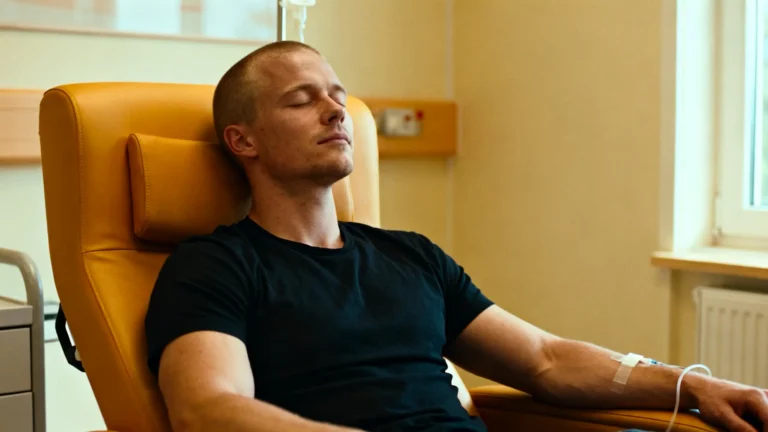
Spravato is FDA-approved esketamine, given as a nasal spray under direct supervision in a certified clinic.
Sections
Spravato is FDA approved esketamine, given as a nasal spray under direct supervision in a certified clinic. It’s the only legal-and-insured version of ketamine for treatment-resistant depression (TRD, which is the technical name for depression that hasn’t responded to at least two adequate antidepressant trials from different classes). It’s expensive, it’s a real time commitment, and for the right patient it does something that nothing else in psychiatry does. This post is about the math of actually doing it, because the brochure version skips the parts that matter.
Esketamine is one of the two mirror-image forms of the ketamine molecule. Both work on the NMDA receptor (a glutamate-system receptor that’s involved in how your brain makes new connections, and which most older antidepressants don’t touch at all). The pharma argument is that esketamine is more potent and the dose can be lower. The clinical reality is that IV racemic ketamine, the version with both mirror-image forms in it, works basically as well and is dramatically cheaper (Terao et al. 2024). The reason Spravato exists in the legal form it does is that nobody could patent generic ketamine, so a manufacturer patented the isomer and the nasal delivery and the supervised administration protocol, which is how American pharma works. The molecule is the same molecule the anesthesiologists have been giving patients since the 70s. The packaging is the new part.
What the schedule actually looks like
Induction phase: twice a week for four weeks. Eight visits. Each visit you come into the certified clinic, get a baseline blood pressure check, take the nasal spray under direct supervision, then sit in a recovery room for two hours minimum while a nurse keeps checking on you. You can’t drive home. You need a ride. Plan on three hours per visit, door to door. There’s no shortcut to this. The two-hour observation is part of the REMS program (the FDA’s risk-management protocol for the drug), and the certified clinic is liable if they let you walk out early.
Maintenance phase: once a week for the next four weeks, then once every two weeks indefinitely, or once a week if every-two-weeks doesn’t hold you. Some patients eventually space out to monthly. Most stay at every two weeks for the long haul.
That’s roughly thirty visits in the first year if things go well. If you have a job that’s not flexible about taking half a day off twice a week for a month, this is going to be a problem before the drug even gets a chance to work. The protocol math is its own filter for who can actually do it.
What it costs
List price is around $700 to $900 per dose. You need two to four doses per visit depending on the protocol step. So per visit, drug cost alone is $1,400 to $3,500. The clinic charges a facility and supervision fee on top, usually a few hundred dollars per visit. Without insurance, you’re looking at $5,000 to $10,000 a month for the induction phase.
With commercial insurance, most plans cover it after prior authorization, which is annoying and slow but doable. Out of pocket is usually a copay plus a coinsurance percentage. Medicare covers it. Medicaid in Oregon and Washington covers it with prior authorization, sometimes more grudgingly and with more paperwork than the commercial plans. Janssen’s copay assistance program can drop commercial out of pocket significantly. Use it. The drug is one of the few where the manufacturer assistance is actually built to work, probably because they know the price would otherwise filter out most of their market.
What it actually feels like
Dissociation. That’s the experience. For about an hour after the dose, your sense of your body, of time, of the room, gets weird. Some patients find it pleasant, some find it uncomfortable, some find it boring, and almost everyone says it’s strange. Around hour two, it fades and you feel pretty normal, maybe a little tired. You can drive the next morning, you can work, you can be a person.
You don’t get high in the recreational sense. You’re not euphoric. You’re somewhere else for a while. A small minority of patients have a dysphoric experience and don’t want to keep doing it, where the dissociation feels bad rather than just weird. We can usually adjust the dose down or pre-medicate with something to take the edge off, which works for most of those patients.
Antidepressant effect: for patients who respond, it’s fast. Some patients notice something within the first week, which is genuinely wild compared to SSRIs taking six weeks. About half of treatment-resistant patients have a meaningful response. About a third get into something like remission. Those numbers are dramatically better than starting a fourth or fifth oral antidepressant, which is the alternative for the same patient population, and which has response rates that decline with each added drug (Rush et al. 2006).

What’s nice to hear about this one
If we’re being honest, the Spravato arc at its best is one of the more dramatic things in psychiatry to be part of. The pattern: picture a guy who’s been depressed in a real, debilitating way for years, has tried Zoloft, Lexapro, Wellbutrin, Effexor, has added lithium, has added Abilify, has done six weeks of TMS (transcranial magnetic stimulation, the magnetic-coil-over-the-forehead treatment) without much help, is holding down his job by sheer grit and his wife is tired of hearing him say he’s thinking about not being around anymore. Get him into Spravato. First two weeks, no real change, the visits are exhausting, he hates the dissociation. Week three, he texts on a Thursday morning: I felt happy at breakfast today, first time in a year and a half. By week six, something like remission. Still tired, still has some hard days, but the floor he’d been living on has lifted. Two years into maintenance, every two weeks he drives to the clinic, gets dosed, has the strange hour, drives home a few hours later. He calls it the most expensive part-time job he has, except he pays for it instead of getting paid, and it’s the only thing keeping him here. That arc is real. The drug isn’t the right answer for everyone, but for the patients it’s right for, it’s genuinely the difference between a life and not one.
He calls it the most expensive part-time job he has, except he pays for it instead of getting paid.
Twice weekly for 4 weeks, then taper
Induction phase is 8 visits in 4 weeks. Then weekly for 4, then every other week long-term. Two hours of observation per visit, no driving.
About half respond, about a third remit
Fast onset, often within the first week or two, which is wild for an antidepressant. Better numbers than starting a fourth oral agent.
$5K-$10K/month cash, much less with insurance
Most commercial plans cover with prior auth. Use the Janssen copay program. Without coverage, the math doesn’t pencil out for most patients.
Cardiovascular caveat
Worth being honest about. Blood pressure goes up briefly during dosing, sometimes meaningfully. Patients with untreated or unstable high blood pressure aren’t candidates until that’s under control. Patients with significant cardiac disease, recent heart events, or unstable cardiovascular conditions, the same. The supervised observation isn’t just for the dissociation. It’s for the pressure spike. Any clinic running Spravato is checking pressures at baseline, at 40 minutes, and again before discharge, and any prescriber who pretends this part of the protocol is optional or unnecessary is being careless.

Who shouldn’t try this
Active substance use disorder, especially with stimulants or hallucinogens. Active psychosis or a history of psychotic depression. Untreated high blood pressure. Unstable cardiovascular disease. Recent intracranial bleeding or trauma. Pregnancy. Patients who can’t get to twice-weekly appointments for a month, because the protocol is the protocol and you can’t shortcut the induction phase without losing the response.

On the autonomy piece
The Spravato conversation is one of the few where the math actually forces the order of operations. If you haven’t tried two oral antidepressants at adequate doses for adequate durations, you’re not technically TRD yet, and most insurance won’t cover Spravato until you are. If you’ve done that and you want to skip to Spravato instead of trying another oral agent or augmenting with lithium or an atypical first, that’s a reasonable choice and we can have it, but the cost and the time commitment have to be on the table. I’m not refusing. The honest take is that for most patients, simpler options that haven’t been tried yet are worth trying first. For patients who’ve actually exhausted them, Spravato is one of the strongest moves available, and the response rates back that up.
Bottom line
Spravato is a real option for treatment-resistant depression, and the response rates are better than anything else at this point in the algorithm. The cost is enormous, the time commitment is enormous, the experience is weird. For the patient who has tried multiple other things and is sinking, all of that’s worth it. For the patient who hasn’t actually given two or three oral antidepressants a real run, the simpler options come first… not because Spravato wouldn’t work, but because the trade offs of this protocol only make sense after the cheaper options have been honestly exhausted.
Sources
- Daly EJ, Singh JB, Fedgchin M, et al. Efficacy and safety of intranasal esketamine adjunctive to oral antidepressant therapy in treatment-resistant depression: a randomized clinical trial. JAMA Psychiatry. 2018;75(2):139-148. PMID 29282469.
- Popova V, Daly EJ, Trivedi M, et al. Efficacy and safety of flexibly dosed esketamine nasal spray combined with a newly initiated oral antidepressant in treatment-resistant depression. Am J Psychiatry. 2019;176(6):428-438. PMID 31109201.
- Wajs E, Aluisio L, Holder R, et al. Esketamine nasal spray plus oral antidepressant in patients with treatment-resistant depression: assessment of long-term safety in a phase 3- open-label study (SUSTAIN-2). J Clin Psychiatry. 2020;81(3):19m12891. PMID 32316080.
- Terao I, Tsuge T, Endo K, et al. Comparative efficacy- tolerability and acceptability of intravenous racemic ketamine with intranasal esketamine- aripiprazole and lithium as augmentative treatments for treatment-resistant unipolar depression: a systematic review and network meta-analysis. J Affect Disord. 2024;346:49-56. PMID 37949235.
- Rush AJ, Trivedi MH, Wisniewski SR, et al. Acute and longer-term outcomes in depressed outpatients requiring one or several treatment steps: a STAR*D report. Am J Psychiatry. 2006;163(11):1905-1917. PMID 17074942.