Sections
High-dose ketamine done in a clinic is a different animal from the troches you take at home. Same molecule, different dose, different route, and a completely different experience. At home protocols run sublingual lozenges in the 100 to 400mg range, dosed for a light dreamy state you can ride out on your couch. In-clinic high-dose ketamine is 0.5 to 1mg/kg IV over 40 minutes for treatment-resistant depression, or higher still for ketamine-assisted psychotherapy where the goal is full ego dissolution. We’re talking about a 70kg patient getting 35 to 70mg IV, which puts most people somewhere they can’t drive home from.
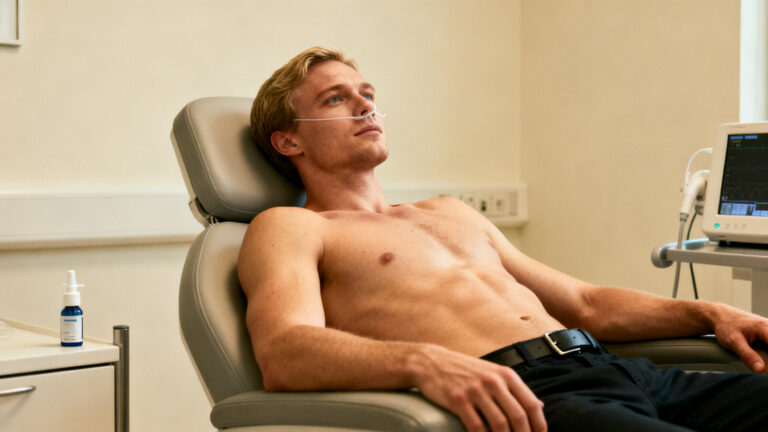
The reason this happens in a clinic and not at your kitchen table isn’t squeamishness. Blood pressure goes up, heart rate goes up, some people get nauseous, and a small subset get genuinely panicked partway through and need somebody trained to talk them down without yanking the IV. None of that’s catastrophic with proper screening, but it’s not zero either, which is why ketamine at this dose lives in a room with a pulse oximeter (the clip on your finger that watches your oxygen levels) and somebody who knows ACLS (the cardiac-arrest protocol every ER doctor and anesthesiologist carries in their head).
The dissociation is a side effect of the dose, not the mechanism that lifts the depression.
What the dose buys you, and why it has to be in a clinic
The IV protocol with the most evidence behind it is Krystal’s original 0.5mg/kg over 40 minutes for TRD (treatment-resistant depression, the technical name for depression that hasn’t moved on two adequate antidepressant trials). That’s the dose the original Yale trials used and it’s still the modal dose at most legitimate ketamine clinics. Some clinicians titrate up to 0.75 or 1mg/kg if a patient doesn’t respond at the standard dose. For ketamine-assisted psychotherapy where the goal is a deeper non-ordinary state for trauma work, doses run higher, 1 to 1.5mg/kg IM, sometimes more.
IM versus IV matters. IV is a tight, controllable infusion you can stop if something goes sideways. IM is one injection and you’re committed to the full duration, roughly 45 to 60 minutes of peak. Most depression clinics run IV, most KAP clinics run IM, both work. The choice is mostly about what the clinician was trained on and what the room is set up to handle.
The infrastructure isn’t optional. A recliner that fully reclines, a quiet room, a blood pressure cuff that cycles every five minutes, continuous pulse ox, somebody in the room or right outside who can manage an airway if the rare bad thing happens. Most clinics doing this well have at least one staff member with anesthesia or ER training. The ones that don’t are cutting a corner I wouldn’t cut.
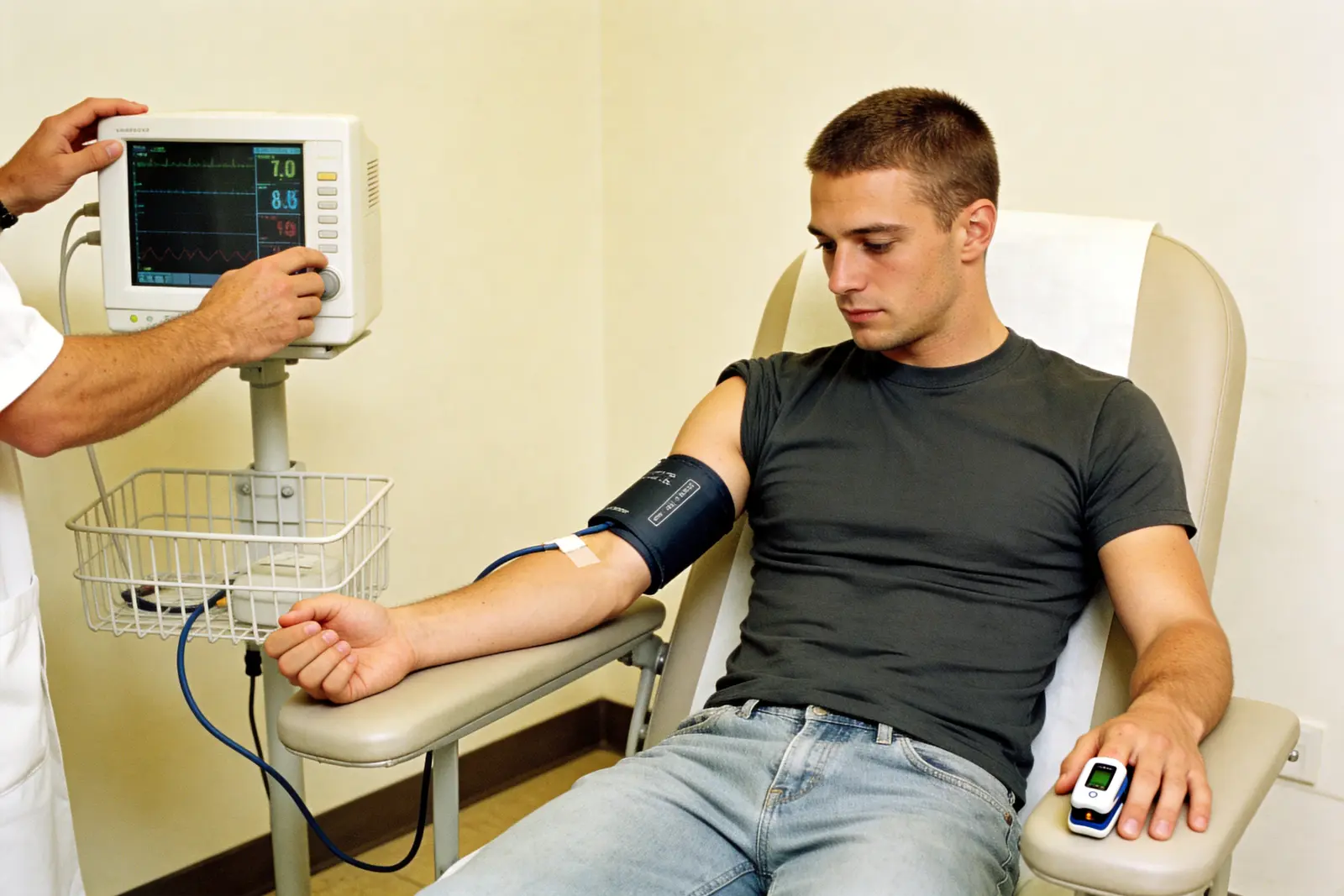
Blood pressure is the one to watch. Ketamine bumps systolic pressure around 16 points on average, more in older or hypertensive patients, and diastolic 10 to 15 during the infusion (Ansari et al. 2024). In a healthy thirty five year old that’s a non-event. In a sixty-two year old with poorly controlled hypertension it’s the reason we screen before we dose. People with unstable cardiac disease, recent stroke, or uncontrolled hypertension don’t get ketamine at these doses. People with active psychosis or a strong family history of schizophrenia don’t either. Worth being honest about the cardiac piece: not to be Chicken Little about it, but anybody on multiple cardiac meds is an iffy candidate at this dose, and any clinic that tells you the cardiac side is no big deal is misrepresenting what the drug actually does. The honest version is that with proper screening the risk is small, without proper screening it’s not.
The experience at 0.5 to 1mg/kg, roughly
This is where in-clinic ketamine diverges hard from the at home version. At 100 to 200mg sublingual, most people get a mild floaty feeling, some time distortion, mood elevation, they can still talk to you and they remember most of it.
At 0.5mg/kg IV somewhere around minute 8 to 12, the room stops feeling like the room. Visual field goes geometric or tunneled, the sense of having a body recedes, people often describe being “above” themselves or part of a pattern, or the boundary between themselves and everything else getting blurry. Some cry, some laugh, some lie completely still and only later say it was one of the most significant experiences of their life… some don’t enjoy it at all and still get the antidepressant effect a few days later. The lack of correlation between in-session experience and antidepressant outcome is one of the genuinely odd things about this drug.
At 1mg/kg IV or 1.5mg/kg IM you’re in K-hole territory, which is the recreational nickname for full ego dissolution, not metaphorically. The person isn’t interacting, they’re somewhere else entirely for about 30 to 40 minutes. This is the dose range used for KAP with trauma where the therapeutic theory is that the patient needs to step fully outside their default self to access material the default self has been guarding.
People walk out of session one asking whether they did it right. Nobody knows whether you did it right until we check the depression score at session four.
The reason I say it that way: plenty of people have a wild, beautiful, profound in-session experience and feel basically the same a week later. Plenty of people have a session they’d describe as “weird, kind of unpleasant, I don’t get the hype” and wake up the next morning noticing their depression has lifted in a way nothing else has touched in years. The dissociation is a side effect of the dose, not the mechanism that lifts the depression. People conflate the two constantly, including some clinics that should know better.

The six-infusion induction, and what comes after
The standard protocol for TRD is six IV infusions over two to three weeks, usually twice a week. The reason for six and not three or ten is that the original trials were structured that way and the response curve flattens around session four to six. People who are going to respond usually show it by infusion three or four. If nothing’s moved by six, more of the same probably won’t either, and that’s the point at which an honest provider talks about switching strategy instead of charging you for another round.
Say you’ve got a patient with years of depression behind him who’s done four SSRIs (the standard antidepressant class, Zoloft and Lexapro and that family), an SNRI (the next class up, Effexor or Cymbalta), lithium augmentation, two rounds of TMS (transcranial magnetic stimulation, the magnet-on-the-head treatment for treatment-resistant cases), the full ladder. Standard TRD picture. He does the six-infusion induction, and somewhere around session three he calls his kid and says he was laughing at something on the radio that morning, and the kid cries because nobody has heard their dad laugh like that in a decade. That’s the kind of response that earns ketamine its place when it works. It doesn’t always work. When it does, it’s fast in a way nothing else in psychiatry is, and the fast piece is what makes it useful in patients who can’t afford to wait the slow drugs out.
Six sessions, 2-3 weeks
0.5mg/kg IV over 40 minutes, typically twice a week. Response usually visible by session three or four. If nothing’s moved by session six, more of the same probably won’t either.
Boosters every 2-6 weeks
After induction, most responders need ongoing single sessions to hold the gains. Spacing depends on how long your response lasts. Some people stretch to 8 weeks, some need 2.
BP, HR, SpO2
Continuous pulse ox, cuff cycling every 5 minutes, staff with anesthesia or ER training in the building. Systolic pressure climbs around 16 points on average during infusion, more in older or hypertensive patients.
Maintenance is the part nobody talks about enough up front. The induction gets the press, the maintenance is what decides whether you’re functionally well a year later. Most responders need single booster infusions every 2 to 6 weeks indefinitely, or they slide back. A subset can stretch the interval out to months. A small subset get a durable remission off a single induction series. I tell people to plan for ongoing maintenance and be pleasantly surprised if they don’t need it, because going the other direction (planning for one and done, then watching the depression come back) is the version that wrecks people.
The dissociation is the price of admission, not the show.
Who needs in-clinic versus at home
At home low-dose troches make sense if you’re functional, your depression is moderate, you’re working with a prescriber who actually checks in on you, and you’ve got the discipline to use them as prescribed rather than as a recreational supply. They’re cheaper, more convenient, and the lower dose means lower risk. For a lot of patients that’s the right rung.
In-clinic high-dose makes sense if you’re severely depressed, acutely suicidal and need something that works in days rather than weeks, have TRD that hasn’t moved on multiple medication trials, have PTSD you want to work on with a KAP-trained therapist, or you tried at home and got nothing. The clinical setting lets us push the dose to where the evidence is strongest, with the monitoring to make that safe.
One last thing: cost is real and insurance is patchy. A six-infusion induction usually runs four to six thousand dollars cash, maintenance runs four to six hundred per session. Spravato (the FDA approved esketamine nasal spray) is covered by more plans and worth asking about if cost is the barrier. Whoever you go to should give you a real number before you commit. A clinic that won’t put numbers on paper before you start the course isn’t the clinic for you.
Before patients walk into the room, I tell them the same thing every time. We’re aiming for them to be measurably less depressed in three weeks. The geometric visuals, the floating-above-the-body sensation, all of it’s just what the molecule does at this dose, some people find it beautiful and some people find it tedious and both groups respond to the antidepressant effect at roughly the same rate. The dissociation is the price of admission, not the show.
Sources
- Berman RM, Cappiello A, Anand A, et al. Antidepressant effects of ketamine in depressed patients. Biol Psychiatry. 2000;47(4):351-354. PMID 10686270. (Foundational ketamine antidepressant trial)
- McIntyre RS, Rosenblat JD, Nemeroff CB, et al. Synthesizing the Evidence for Ketamine and Esketamine in Treatment-Resistant Depression: An International Expert Opinion on the Available Evidence and Implementation. Am J Psychiatry. 2021;178(5):383-399. PMID 33726522.
- Daly EJ, Trivedi MH, Janik A, et al. Efficacy of esketamine nasal spray plus oral antidepressant treatment for relapse prevention in patients with treatment-resistant depression: a randomized clinical trial. JAMA Psychiatry. 2019;76(9):893-903. PMID 31166571.
- Kim JW, Suzuki K, Kavalali ET, Monteggia LM. Ketamine: Mechanisms and Relevance to Treatment of Depression. Annu Rev Med. 2024;75:129-143. PMID 37729028.
- Dean RL, Hurducas C, Hawton K, et al, Ketamine and other glutamate receptor modulators for depression in adults with unipolar major depressive disorder, Cochrane Database of Systematic Reviews, 2021, Issue 9, CD011612. PMID 34510411.
- Ansari M, Pittman B, Tylee DS, et al. Blood pressure changes during ketamine infusion for the treatment of depression. Gen Hosp Psychiatry. 2024;90:62-67. PMID 38991311.