Morning wood is a clue about whether the hardware still runs on its own. What it means, when it doesn't mean much, and when to pay attention.
Sections
Morning wood is one of those things guys only notice when it changes, nobody writes a journal entry about it when it’s there, but let it go missing for a few weeks and suddenly it’s a referendum on testosterone, masculinity, arteries, porn, aging, and whether your body is quietly falling apart before breakfast.
The actual story is less dramatic and more useful once you know what to look for, so here’s what to look for. Waking up with an erection, or at least knowing you’re still getting erections in sleep, is one of the rough clues clinicians use when sorting out erectile problems. Not a perfect test, but it does tell you whether the plumbing can still run the sequence on its own, and when that disappears consistently it’s worth paying attention instead of just hoping it comes back on its own.
What morning wood actually is
Morning wood is the lay version of sleep-related erections, sometimes called nocturnal penile tumescence. Men get erections during sleep, especially during REM sleep, without trying to, without fantasizing, without any deep symbolic meaning attached. It’s just the body running on autopilot, which is exactly why it’s useful as a clue when somebody says his erections are failing while he’s awake. The useful part is that sleep erections happen outside the whole performance loop, no partner in the room, no pressure, no self-monitoring, no “is it working yet” commentary running in the background.
If a guy can still get solid erections during sleep or wakes with them reliably, the hardware can still run the sequence on its own, which is exactly why the question matters. That doesn’t prove the problem is all in your head, but it does point away from major hardware failure and toward the usual suspects: stress, performance anxiety, alcohol, an SSRI, or just a bad stretch.
The AUA erectile dysfunction guideline still treats this as part of a basic history. When a man comes in with erection trouble, you ask whether the problem is getting hard, staying hard, whether it happens in every context, whether masturbation works, and whether nocturnal or morning erections are still there. Those questions aren’t trivia, they’re how you sort out whether you’re looking at a global problem or something more situational.

What its presence usually tells you
If you’re waking up with decent erections, or you know you’re still getting them at night, that’s usually reassuring. The body can still run the erection sequence without you having to think your way into it. In the real world that often points toward the kind of erection problems that show up only under certain conditions: with a partner, after a few drinks, after a bad week, after a relationship blowup, after an SSRI, after too much porn and too much self-surveillance layered on top of it. The body still knows how to do it, the conditions around sex are just what changed.
A lot of young men skip right past this distinction, have a few bad nights, panic immediately, and start acting like their arteries have collapsed at twenty-seven. Usually that isn’t the story. Usually the story is some ugly mix of stress, hypervigilance, sleep debt, and then the performance anxiety that grows on top of the original miss. Morning wood doesn’t solve that, but when it’s still there it does argue against the bleakest explanation.
What its absence does and doesn’t tell you
The absence of morning wood is more complicated. One missing morning means nothing. A bad night of sleep, a couple of drinks, being up half the night, a head cold, sleeping in a weird position, plain chance, any of that can do it. You don’t diagnose yourself off one Tuesday.
- One missed morning means almost nothing.
- A months-long change plus weaker erections everywhere deserves a workup.
- Sleep, alcohol, medications, blood pressure, glucose, lipids, and testosterone can all matter.
Morning wood is just one signal. It can tell you something about blood flow, hormones, sleep, and stress, but it isn’t a manhood score.
What matters is the pattern. If morning erections used to be common and now they’re rarely or never there, especially if erections are also weaker in every other setting, that’s worth taking seriously. The older literature on healthy aging found that frequency and duration of nocturnal erections drop with age even in men who are still sexually active. So yes, age changes the baseline. But “less common than when I was twenty-two” isn’t the same thing as “gone across the board,” and those are two buckets people need to stop lumping together.
It’s also not a perfect divide between body and mind. Depression, smoking, aging, sleep disorders, and even dream content can affect the recordings. A normal sleep-erection pattern usually points toward ED that’s mostly in your head, but not always. An abnormal pattern can point toward a real physical cause, but not always. Anybody treating it like a definitive answer in either direction is a damn liar, because one data point doesn’t settle the whole question.
Sleep, testosterone, and the missing-morning-wood spiral
Sleep is a big part of why guys get confused about this, because sleep-related erections ride on sleep architecture, especially REM. If your sleep is fragmented, if you’re sleeping four hours a night, if you’ve got untreated sleep apnea, if stress is blowing up your REM cycles, then the erections riding on that sleep can get worse too. That doesn’t mean the penis is the primary problem. Sometimes the problem isn’t the penis at all, it’s just downstream of trashed sleep.
Testosterone is part of the picture, though not in the simplistic internet-forum way where low T explains everything. One older but still useful study found that hypogonadal men had substantially less nocturnal tumescence and rigidity during sleep, while their erectile response to visual erotic stimuli was less affected. The short version is that low testosterone tends to show up more clearly in the background physiology than in some one-off waking response. That’s one reason why consistently absent morning erections, plus low libido, lower energy, or other signs of hypogonadism, deserve an actual lab check instead of a Reddit diagnosis.

You can absolutely have normal testosterone and still lose morning wood for a stretch because your sleep is trashed, your nervous system is pinned, or your erections are being blunted by an antidepressant or heavy alcohol use. Turning every erection problem into a testosterone story is lazy. Most of the time it’s just wrong.
When you should actually pay attention
There are a few versions of this that deserve a real look. If morning erections have dropped off for months, not days, and erections are weaker in every context, alone included, go get it checked. Same if the change showed up alongside lower libido, fatigue, or obvious hormonal clues, or if you’ve got the usual vascular-risk stuff in the background, blood pressure, diabetes, smoking, high cholesterol, weight gain, because ED can be an early warning sign from the same system that later gives people heart trouble. Same again if the change started after a medication and no one has connected the dots yet.
If you’re over forty and the whole picture has been slowly fading, that’s a different conversation than the twenty six year old who can get hard alone, gets morning wood three days a week, and falls apart only when a partner is in the room. They’re not the same problem, and if you treat them the same, a twenty six year old ends up on testosterone he doesn’t need.
What the workup usually looks like
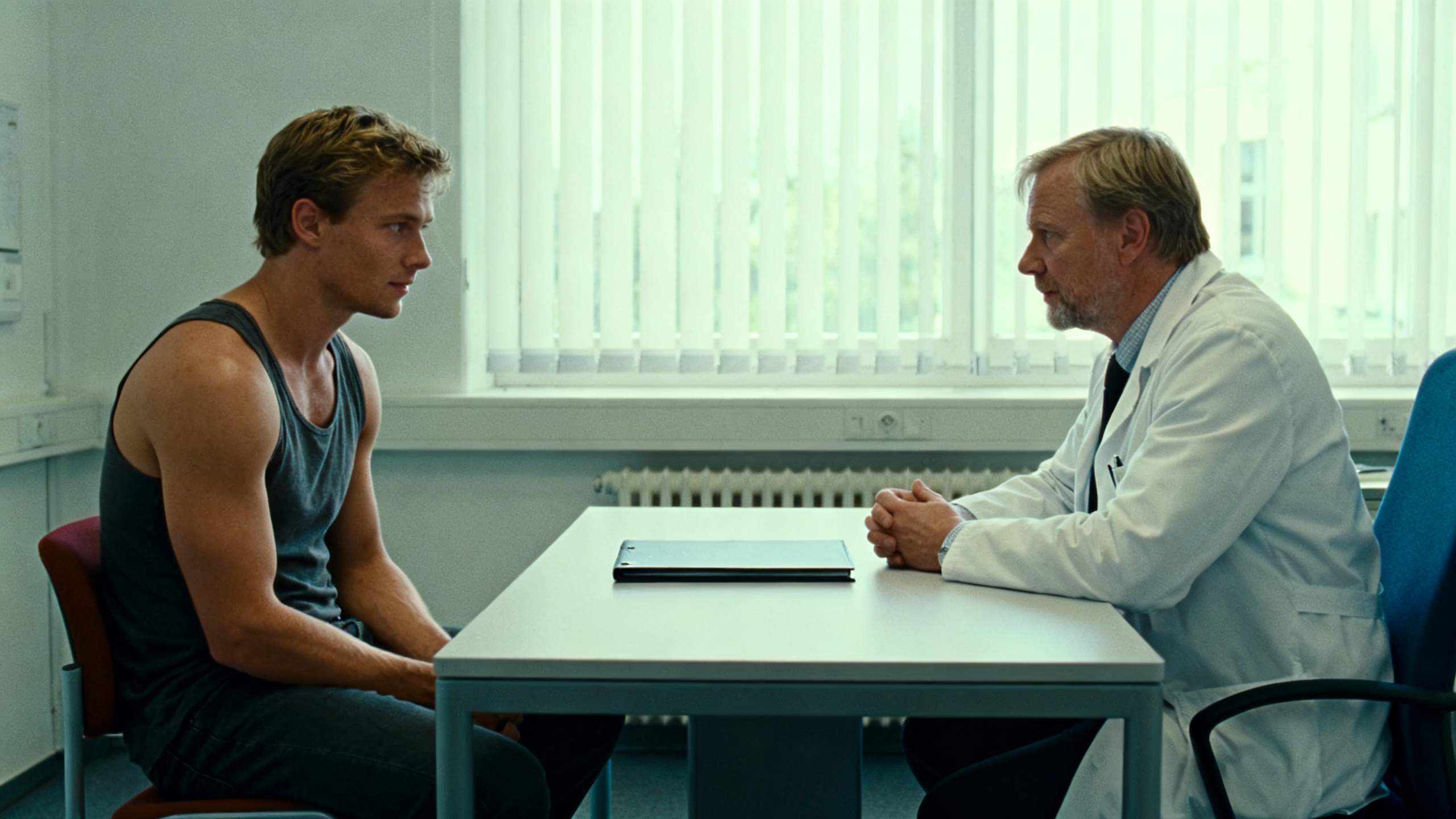
Most of the time this doesn’t require some exotic test. Usually it starts with a doctor asking the obvious stuff: are erections gone everywhere or only with a partner, are you still getting them at night, what changed, what’s on your med list, how much are you drinking. Then maybe labs if the story calls for it, testosterone, glucose or A1c, lipids, thyroid depending on the rest of the picture. The AUA doesn’t recommend some generic maximalist test panel for every guy who mentions erections. So if you came in saying erections only fail with a partner and you’re still getting morning wood, nobody should be ordering a full hormone panel just to feel thorough.
Formal nocturnal penile tumescence testing exists, usually with RigiScan or sleep-lab setups, but that’s not where most people start and it isn’t needed for every guy who has a bad month. It’s a niche diagnostic tool, useful in selected cases, and even the review literature spends a lot of time on its limitations. So no, the next step usually isn’t sleeping in a lab with wires on your penis. The next step is usually a doctor asking you the right questions, and honestly, a doctor asking you about your erections is less weird than you’re building it up to be.
Bottom line
If it’s still happening most mornings, the body can still run the sequence on its own, which is actually the only thing morning wood needs to tell you. If it’s been consistently gone for a while, especially along with weaker erections everywhere else, lower libido, bad sleep, or obvious health drift, then yes, pay attention and get it checked.