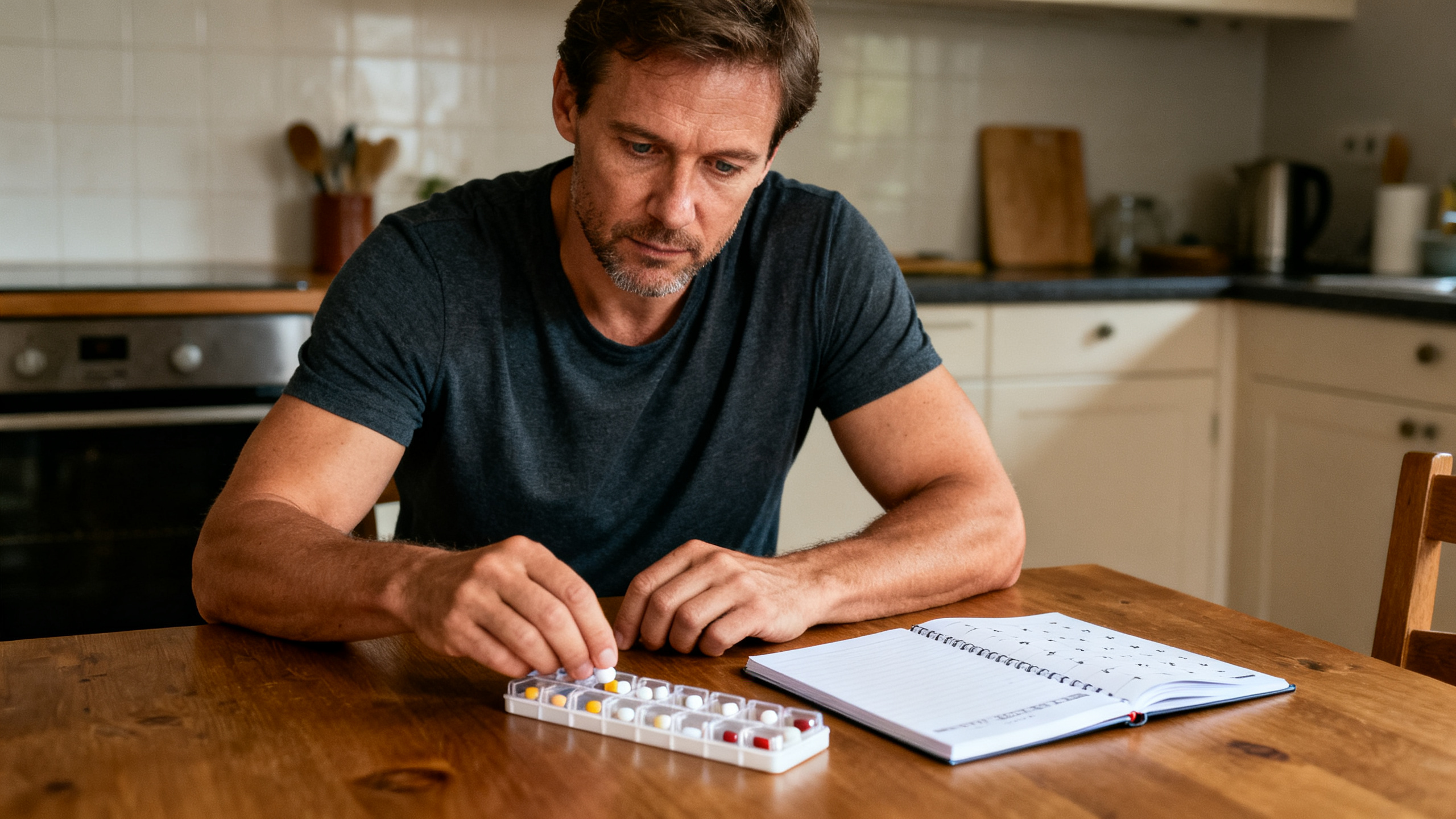
Prozac came out in 1987. Almost forty years later it's still on the short list of SSRIs I reach for, and not because of nostalgia.
Sections
Prozac came out in 1987 and almost forty years later it’s still near the top of my short list. Fluoxetine (the generic name for Prozac) does one thing none of the other antidepressants in its family really pull off, and the whole reason it’s good comes down to one dull little fact: it leaves your body really, really slowly.
Here’s what that means in plain terms. Most of these drugs are gone from your system in about a day. Prozac sticks around for weeks. Even after the original pill clears, your liver (the thing that breaks drugs down) turns it into a leftover version that keeps doing the same antidepressant job for another week or two on top of that. So the drug doesn’t just vanish when you stop taking it, it drifts out gradually on its own. You can quit it cold on a Friday and the level in your blood eases down over the next two or three weeks while you barely notice a thing. Quit Paxil that same Friday (Paxil is the one in this group with the meanest comedown) and you’d be in withdrawal by Monday morning, sweating through a shirt, feeling weird and wired, like somebody snuck into the room overnight and moved everything two inches to the left.
You can stop Prozac cold and barely feel it leave, because it takes weeks to clear out on its own.
That one property changes how I prescribe it. Prozac is the one I reach for when somebody’s probably going to be flaky about taking a pill on schedule, when they travel a lot for work, when another antidepressant already put them through withdrawal hell, or when I don’t know yet whether we’ll be on this thing for the long haul. Miss a dose, skip a few, quit without telling me, and the drug just shrugs and keeps going.
Why the slow exit keeps mattering
Withdrawal coming off the fast-clearing antidepressants is real, and it’s badly underrated by people who don’t have to live through it. Paxil is the worst offender. Effexor (technically a slightly different drug, same headache) is right there with it. People describe brain zaps (a strange little electrical jolt in the head, sometimes set off by moving your eyes side to side), dizziness, stomach trouble, and an irritability that goes from zero to wanting-to-fight-a-stranger-in-the-cereal-aisle in about ten seconds. It won’t hurt you the way quitting a benzo can, it’s just miserable, and that’s what keeps a lot of people stuck on pills they’d rather be off.
Prozac basically doesn’t do any of that. People skip a week of doses on vacation and feel completely fine. People quit it cold against my advice and the worst they report back is feeling a little flatter for a couple weeks. The whole thing is just the drug hanging around long enough to taper itself, which barely sounds like an upside until you’ve watched somebody try to quit Paxil.
There’s a clinical trick that falls right out of this. When I need to peel somebody off Paxil or Effexor and they keep blowing the taper, I’ll switch them onto a single dose of fluoxetine, let the Prozac wash in while we drop the drug that’s giving them trouble, then taper the Prozac slowly over months. Because it leaves so slowly, it smooths the whole handoff. It’s not some secret move, plenty of psychiatrists do it, but it’s a lifesaver when somebody’s been welded to Paxil and can’t get off without coming apart at the seams.
The jumpy first week or two
Here’s the catch, and it’s the flip side of the same coin that makes the drug good: Prozac revs you up more than the others in its family do. It’s the one most likely to make an already-anxious person feel worse before they feel better. Jittery. Wired. Sleep goes sideways for the first ten days or so. A lot of guys describe it as feeling like they mainlined coffee for a week straight, which isn’t the vibe anybody signed up for, and it passes.
Say you’ve got a guy who walks in with what’s mostly run-of-the-mill anxiety with a layer of depression on top. He was doing okay off meds for a long stretch, then life leaned on him and tipped him over. You start him on 10mg, the low dose you’d use for an anxious person, and he still calls you on day four convinced something has gone deeply wrong. Heart pounding at night, intrusive thoughts, can’t sit still. None of that’s the depression getting worse, it’s just the drug spinning up.
You hold the dose, maybe add a little hydroxyzine (an old allergy pill that takes the edge off anxiety without being habit forming) for sleep, and by day twelve he’s evened out. By week six he’s the most functional he’s been in ages. But if nobody warned him that week one might feel rough and that the plan is to ride it out, he’d have quit on day five and filed Prozac under medications that “didn’t work for me.” It’s a big part of why guys decide antidepressants don’t work, they quit in week one, before the thing ever kicked in.
For pure-anxiety folks with no depression in the mix, I tend to lean toward escitalopram or sertraline instead, just to dodge that jumpy bump at the start. Prozac for an anxious-depressed person still earns its spot, you just have to tell him week one might suck and then check in while it passes.

One of the few we have for kids
This is where Prozac runs basically unopposed. It’s the only one of these drugs the FDA signed off on for both depression in kids (age 8 and up) and OCD in kids (age 7 and up). Lexapro picked up an approval for teens later on, but for the under-12 crowd fluoxetine is pretty much the only one that bothered to do the paperwork.
And the research behind that approval is pretty solid, which I can’t say about every kids’ psychiatric drug. The big TADS study back in the early 2000s put fluoxetine head to head against CBT (the structured worksheet-and-homework kind of therapy, not the talk-about-your-mother kind), against the two combined, and against a sugar pill in depressed teens, and the combo of medication plus therapy came out on top. Fluoxetine on its own beat therapy on its own in the early going, which surprised a lot of people at the time and probably should have surprised fewer of them.
I’m careful with kids. I don’t put them on these drugs casually. But when a kid really needs a medication, fluoxetine is my default. The slow exit pays off here too, because kids are even worse than adults about taking a pill on schedule, and a missed dose or two with Prozac just doesn’t matter. With one of the fast-clearing drugs, the kid would be riding a little withdrawal rollercoaster every single weekend.
How it bumps into your other meds
Prozac and its leftover form both gum up some of the machinery in your liver that breaks down other drugs. The practical upshot: when you’re on Prozac, certain other pills can build up higher than they should, or in a couple of cases stop working at all. This matters way more than people give it credit for, and it’s the one place where the slow exit works against you, because the drug keeps gumming up that machinery for weeks after you stop it.
The classic landmine is taking it alongside tamoxifen (a breast cancer drug that only works after your body converts it into its active form). Prozac jams the exact step that does that conversion, so it can blunt the cancer drug, and that’s the sort of thing that can matter a whole lot. Cancer doctors generally know this. Some psychiatrists don’t. I always check what else somebody’s taking and just steer around Prozac in anyone on tamoxifen.
The other one is opioids. Codeine and tramadol both have to be switched on by your body before they kill any pain, and Prozac blocks the switch, so it basically takes the pain relief out of them. Say a guy who’s been on fluoxetine a while gets sent home from the ER with tramadol after a kidney stone and it does nothing for the flank pain. Six pills over twelve hours and he’s still pacing the kitchen at 3 AM. If nobody in the ER checked what else he was taking, here’s the trap: he gets quietly labeled drug-seeking or pain-tolerant, when the real problem is the Prozac shut off the very step that’s supposed to turn that pill into something useful, so it was basically dead before he swallowed it.
10 to 80mg
Most adults land between 20 and 40mg. Kids usually 10 to 20mg. OCD often needs the higher end, 60 to 80mg, and takes longer to respond than depression does.
Slow, by design
The pill itself lingers for days, and the leftover your liver makes from it for a week or two more. Takes about a month to fully build up, and another month to fully clear. That slow exit’s the whole point.
Five FDA approvals
Depression, OCD, bulimia nervosa, panic disorder, and PMDD. Plus depression and OCD in kids. Off-label use is broader still.
It also nudges up the levels of the older antidepressants people call TCAs, certain antipsychotics (Risperdal especially), and some blood-pressure pills. If I’m adding Prozac onto somebody who’s already on a complicated stack of meds, I run through everything they’re taking and look for anything Prozac might shove around. Not because something catastrophic usually happens, but because mild trouble is easy to miss and stupidly easy to prevent, and I’d rather spend the two minutes.

The good news on it
For a fair slice of the guys who come in with depression and a side of anxiety, Prozac at 20mg gets the job done, costs about a sandwich a month, and doesn’t lock you into a medication you can’t crawl back out of later. That last bit matters more than it sounds like it should. People argue all day about whether it works. Barely anyone asks the other thing that matters, whether you can get back off it without a week of brain zaps. Prozac wins on that second part by a margin nothing else really touches, which makes the whole decision to start it lower-stakes. If it doesn’t work, getting off it’s a non-event, and you didn’t quietly sign up for a brutal withdrawal nobody warned you about. That’s the part I want people to hear before they fill the script, because it’s easy to forget once you’re busy warning them about the rough first week.

Why it’s still around
New psychiatric drugs roll out every few years, and most of them are slightly tweaked versions of older drugs with worse data and a fatter marketing budget, which tells you most of what you need to know about my industry. Prozac has been out long enough that the patents expired decades ago, the generic runs about four dollars a month, and we know more about its long-term safety than just about anything else in psychiatry. It already proved it isn’t going to surprise you in year ten.
It isn’t the right pick for everybody, and I’m not going to pretend it is. Pure-anxiety cases often do better on escitalopram. Anybody who needs a fast response shouldn’t be starting anything in this family. Anyone on tamoxifen or daily opioids needs a different option entirely. But for a fair slice of the depressed and OCD and anxious-depressed folks who walk in the door, Prozac at 20mg is still a reasonable first move that I rarely look back on and regret.
One more thing on letting you steer. If you want the prescription, you get the prescription, I’m a provider, not your dad. I’ll tell you what I really think and you make the call. With Prozac it’s short: it’s cheap and old and it doesn’t lock you in, it’s got a little extra pep so the first week can run rough and it’s worth riding out, and if it doesn’t work after eight weeks at a real dose, getting off it costs you nothing but the time it takes for the drug to drift out on its own.