Trazodone, Silenor, Belsomra, Ambien-class, mirtazapine, Seroquel. What actually helps, what borrows time you pay back later, and where the benzo trap is.
The workhorse first call, it works, it won’t own you, and it’s cheap. Where most people should start.
Belsomra, Dayvigo, Quviviq. No dependence and less morning hangover than the old stuff, the catch is the price.
Ambien, Klonopin and the rest. Fast tonight, but the tolerance and rebound are what make staying on them the real problem.
Sleep is the substrate. It’s the floor everything else in psychiatry stands on, and when the floor is cracked nothing else holds weight the way it’s supposed to. ADHD gets worse without sleep, depression gets worse, anxiety gets worse, weight creeps up, testosterone drops, blood sugar drifts, executive function falls apart, and the patient who walks in for any of those complaints and is sleeping five and a half hours a night on a good week is asking the wrong question first. The sleep question matters even when sleep isn’t what landed the patient in the chair, because every other lever in this work is partly a sleep lever in disguise.
That said, the pill question is real, most of the patients I see have already tried “just sleep better” and bounced off it, and they’re not asking me whether sleep matters, they’re asking which pill is least bad and whether they can stay on it without paying for it later. That’s a fair question, and this piece is the honest answer, ranked roughly by how much each option actually fixes the problem versus how much it just buys you a few hours tonight at a real cost down the line. The pill is leverage on the work, the work is still the work, and both things are true at the same time.

What the patient is already doing wrong before we get to the script
I’m not going to belabor the sleep hygiene checklist because every guy reading this has seen it on five blogs and three sleep podcasts, but the pill conversation can’t skip this conversation, and the things I find when I ask in detail are the same handful of things every time. Caffeine after 2 PM, more common than patients admit, the 3 PM espresso doesn’t feel like it’s still working at 11 PM and it absolutely is (half-life is five to six hours and the tail runs longer in slow metabolizers). Screens in bed until the moment the light goes out, partly the blue light piece (real but probably overhyped) and mostly the content piece, you’re scrolling and the brain reads that as engagement. Weekend schedule blowouts where Friday and Saturday are 2 AM bedtimes and Sunday night you’re staring at the ceiling trying to be asleep at 10:30 PM and your circadian rhythm is laughing at you. Alcohol as a wind-down, the most common self-medication for insomnia I see, and the one actively wrecking the back half of the night, the first two drinks do put you down… they fragment REM sleep and the 3:30 AM wake-up a lot of guys describe as “anxiety” is sometimes the alcohol wearing off and the rebound arousal hitting.
Stimulants taken too late, taking Vyvanse at 11 AM and wondering why you can’t fall asleep at midnight is a math problem with a known answer. Partner snoring untreated, half a marriage problem and half a sleep medicine problem, ignored by both. Late-night eating that messes with thermoregulation and reflux. And the big one, anxiety unmedicated and looping in bed, because the patient who hasn’t dealt with the anxiety is going to spend the pill on a problem the pill isn’t designed for and conclude the pill doesn’t work. None of this is original advice, all of it works, and the patient who fixes two or three often doesn’t need the pill at all.
Fix two or three of these and a lot of guys never need the pill at all.
Trazodone, the workhorse first call
Trazodone is the medication I reach for first in most chronic-insomnia conversations, and it’s the one most patients have either never tried or tried at the wrong dose. The technical category is serotonin antagonist and reuptake inhibitor (SARI), developed as an antidepressant in the 1980s, turned out to be too sedating at antidepressant doses for most patients, which is the exact reason it landed in the sleep lane as an off-label workhorse at 25 to 100mg at bedtime. The mechanism at sleep doses is mostly the antihistamine and the 5-HT2A blockade, the combination puts you down without the GABA-A pathway that benzos and Z-drugs ride, which is the whole reason trazodone doesn’t generate dependency the way those classes do.
The selling point is the boring one, it isn’t addictive, it doesn’t build dependency, and there’s no rebound insomnia worth mentioning when you stop, and if I can solve the patient’s sleep with a molecule that isn’t going to own them in two years, that’s the molecule we use. The dosing range is the part most patients fumble, 25mg is a real starting dose for sleep, 50mg gets most adults most of the way there, 100mg is fine if the lower doses don’t hold, and going past 100mg usually buys you morning grogginess, not better sleep.
Side effects worth naming: morning grogginess at higher doses (drop the dose), dry mouth (drink water like you actually like it), mild dizziness on standing in older patients (who can land badly if they get up to pee at 2 AM), and priapism, the side effect that scares everybody when they read the label, real but rare (single-digit per ten thousand kind of rare), the rule is if you get an erection lasting more than four hours you go to the ER and you don’t sit on it because that’s how you lose function. Almost nobody this happens to, and the patients scared off trazodone by the priapism warning are scared because the label is alarming, not because the math is alarming. Where trazodone falls short is the patient who wakes up at 3:30 AM and can’t get back down, because the half-life is short enough (five to nine hours) that the back half of the night isn’t well covered at lower doses, and if maintenance is the bigger problem than onset we may combine it with something else or move to a different class. As a starting point for the patient who can’t fall asleep and doesn’t want to ride the addiction lane, trazodone is the boring right answer most of the time, and the field underuses it because it’s old, generic, and unsexy, which is a bad reason to reach past it for something newer and worse.

If a molecule fixes your sleep without owning you in two years, that’s the molecule we use.
Low-dose doxepin (Silenor at 3mg and 6mg), the gentlest landing
Doxepin is a tricyclic antidepressant from the 1960s, and at the 75 to 300mg doses they used to prescribe it for depression it had the side effect profile of every other tricyclic, which is to say, brutal. Silenor is doxepin at 3mg or 6mg, so low it doesn’t do anything to mood or mid-day function, what it does do is selectively block H1 histamine receptors (the same pathway Benadryl uses to make you sleepy), except cleaner and without the anticholinergic load Benadryl saddles you with. It isn’t addictive, it doesn’t build dependency, and most patients don’t get morning grogginess at the low dose, which is the actual selling point, because it’s the rare sleep medication you can take at 10 PM and not feel slow at 7 AM.
The reason nobody talks about it is partly that branded Silenor was expensive when it came out and insurance fought it, and partly that the older guys in the field remembered doxepin as a tricyclic and assumed the side effect profile carried over, which at the low dose it doesn’t. You can sidestep the insurance fight by prescribing generic doxepin liquid concentrate at 3 or 6mg drops, basically the same thing as Silenor without the brand name and at a fraction of the cost. Who it’s best for, the patient who tried trazodone and woke up too groggy, the patient who can’t take anything with abuse potential because of work or history, the older patient where the addiction-class options are off the table because of fall risk. Side effects at the low dose are minimal (mild dry mouth, occasionally some lingering morning sedation), and it’s the medication I wish more prescribers reached for before they reached for an Ambien refill.
The rare sleep pill you can take at 10 and not feel slow at 7.
Ramelteon (Rozerem), the melatonin-receptor lane
Ramelteon is a melatonin receptor agonist, FDA-approved for sleep onset insomnia, not scheduled, no abuse liability, no dependency, no withdrawal when you stop. On paper that’s the dream profile. In practice the effect is modest, the data shows it shortens sleep onset by something like ten to fifteen minutes in most studies, which is a real effect and also not a dramatic one, and a fair number of patients try it and don’t notice anything at all. It’s the safest sleep medication in the lineup, full stop, and the trade-off for that safety is that the effect isn’t huge. Where it fits is the patient whose specific problem is “I can’t fall asleep, once I’m down I’m fine for the night,” plus the patient who specifically can’t have anything with abuse potential in the medicine cabinet, plus older patients where the risk math on every other class gets sketchy. Insurance is inconsistent, sometimes it’s covered easily, sometimes it’s denied outright in favor of cheaper trazodone (which honestly is usually fine), and ramelteon’s main argument is for the patient where trazodone didn’t work and the next move needs to stay out of the dependency lane.
The safest pill in the lineup, and the price of that safety is a modest effect.
The orexin antagonists: Belsomra (suvorexant), Dayvigo (lemborexant), Quviviq (daridorexant)
These are the newest class, the orexin receptor antagonists, sometimes called DORAs (dual orexin receptor antagonists), and the mechanism is genuinely different from everything else on this list. Orexin is the neurotransmitter system that keeps you awake, the wake signal, and instead of sedating you by pushing GABA harder or blocking histamine, the DORAs work by turning the wake system off. The practical consequence is that this class is better at sleep maintenance than most of the older options, it tends to keep the patient asleep through the night rather than putting them down hard for the first three hours and letting them rebound at 3 AM. For the patient whose chief complaint is “I fall asleep fine, I just can’t stay asleep,” this is the lane that fits, and trazodone is often the lane that doesn’t. Dependency-forming potential is lower than Z-drugs and benzos though not zero (DEA scheduled these as IV, the lowest controlled-substance tier), and the long-run profile looks meaningfully better than the Z-drug long-run.
Side effects worth naming, next-day somnolence at higher doses (especially if the patient took it past 11 PM and is trying to be up at 6 AM), vivid and sometimes weird dream content (some patients love it, some can’t stand it), sleep paralysis occasionally (unsettling but not dangerous), and complex sleep behaviors at higher doses (the sleep-driving and sleep-eating thing Z-drugs are notorious for, less common than with Ambien but not zero, and on the label for a reason). Cost is real, all three are still on patent, insurance fights are common, and patients usually need to have failed trazodone or a Z-drug before insurance will cover one, and once they’re on it most patients who tolerate it stay on it.
The DORAs don’t sedate you to sleep, they take the wake signal offline… that’s a meaningfully different way to handle the problem.
Z-drugs: Ambien (zolpidem), Lunesta (eszopiclone), Sonata (zaleplon)
This is the class the marketing got wrong on purpose for years, and it’s the class most of the patients I see have been on for too long. Ambien, Lunesta, and Sonata are the three in common use, named that because the molecular names start with Z and because the field needed shorthand for “benzo-adjacent without the benzo name attached.” Z-drugs bind to a specific subset of the GABA-A receptor (the alpha-1 subunit, mostly), the same receptor family benzos hit, just at a narrower spot. Shorter half-life than most benzos, different binding profile, the marketing said “not addictive” for years on the strength of those two facts, and the marketing was wrong. Dependency is real, withdrawal is real, rebound insomnia when you stop is real, and the patient on Ambien for eight years who is scared to stop is not an outlier, that’s a population. The honest story is that they do work, and for short-term insomnia (four to six weeks around a stressful stretch) a Z-drug works fine, the patient gets some sleep, the situation resolves, the medication comes off, and we move on. The failure mode is the patient put on it during a divorce in 2017 who is still on it because nobody ever revisited it, who is now convinced he can’t sleep without it, and the truth is he probably can’t anymore, because the brain has adapted around the medication and the unmedicated sleep architecture has been rewired.
The side effects include the sleep-behavior cluster everybody has heard about and most people underestimate, the sleep-driving where the patient takes the Z-drug, doesn’t quite go to sleep, drives somewhere, and has no memory of it the next day, the sleep-eating where the patient demolishes half the kitchen at 2 AM with no recollection, plus the anterograde amnesia where the patient is told he had a forty-minute conversation last night he has zero memory of. All of these are dose-dependent and probability-dependent, and the patient on 10mg of Ambien for three years who has never had any of this happen still has a probability of it happening tonight that isn’t zero. Morning grogginess and a daytime cognitive bill are the other piece, some patients are basically fine while others are paying a cost they haven’t connected back to the medication, and you don’t know which one you are until you taper off. Rebound insomnia on stop is the part that traps patients (three nights of worse-than-baseline sleep, sometimes a week, sometimes longer) and most patients in that stretch conclude the medication was the only thing keeping them functional and they restart it, and that’s the loop. The taper is the answer, not a cold stop, slow dose reductions (dropping by a quarter or a half over weeks, bridging with trazodone or doxepin or a DORA while the Z-drug comes down) are the tool that works, and most of the patients who think they can’t get off Ambien can get off Ambien.
The eight-years-on-Ambien patient isn’t an outlier, he’s a population, and most of them can still get off it.
Benzodiazepines for sleep: Restoril, Klonopin, Ativan, Xanax
Here’s where I’m going to be the most direct, because the field has been worst at being direct on this question. Benzodiazepines for chronic insomnia are a long-term mistake dressed as a short-term fix. Restoril (temazepam) is the one specifically marketed for sleep, intermediate half-life, designed to hit hard at bedtime and clear by morning. Klonopin (clonazepam) is longer-acting, often used off-label for sleep when the patient also has anxiety. Ativan (lorazepam) is shorter, used at bedtime when the issue is acute. Xanax (alprazolam) gets reached for too, usually inappropriately for sleep, the short half-life makes it a particularly bad choice because the rebound arousal in the back half of the night is brutal. The narrow defensible niche where I’ll write a benzo for sleep is severe acute insomnia with a specific endpoint, a patient who hasn’t slept in four nights and is becoming a safety problem at work, three to five days while we figure out the rest. None of that justifies the standing prescription, and the patient on Klonopin nightly for six years for “sleep” is in a worse position than he was before he started, even if his sleep is currently ok, because the cognitive bill compounds, the tolerance drift means the dose has crept up, the fall risk in patients over sixty starts to land badly, and the taper conversation is going to be miserable whenever it finally happens.
The cognitive piece is the part patients dismiss until it bites them, because long-term benzo use produces a measurable drag on memory, processing speed, and executive function, and the patient often doesn’t notice (the drift is slow and they’ve normalized it), then they taper off, and three months later they feel sharper than they have in years and they’re surprised. The fall risk in older patients is the other part, the data on hip fractures and benzo prescriptions in patients over sixty-five is bad enough that the geriatricians have been screaming about it for years. Anybody who frames Klonopin as “the cleaner benzo” because it has a longer half-life is selling you a story that doesn’t hold up over a five-year horizon, the longer half-life means slower clearance, more accumulation, and a harder taper, not a safer molecule. If your prescriber put you on a benzo for sleep and you’ve been on it more than a few months, that’s a conversation worth having.
Klonopin as “the cleaner benzo” is a story that doesn’t survive a five-year horizon.
Melatonin OTC, the part patients mostly get wrong
Melatonin is a hormone your pineal gland already makes, and the OTC supplement version is the same molecule. The mistake almost every patient makes is dosing it like a sleep medication, taking 5 or 10mg an hour before bed and expecting it to knock them down, and that isn’t how the receptor works. The physiologic dose your body makes overnight is in the microgram range, and the data on supplemental melatonin is consistent that lower doses (0.3 to 1mg) often work better than higher doses for circadian effects, because the receptor downregulates with overstimulation. The 10mg gummy at bedtime is doing less than the 0.5mg dose taken at the right time, and a fair number of patients on the high dose are getting the worst of both. What melatonin is actually good for is circadian shift problems, jet lag, shift work, the patient whose sleep schedule has drifted and needs to be reset, and in those cases timing matters more than dose (take it three to five hours before the target bedtime, not at bedtime, and use the low dose). For chronic primary insomnia the data is honestly weak, some patients respond, most don’t, and the marketing wildly overstates what the molecule does for the average insomniac. There’s also a real quality control problem with the supplement industry (independent testing finds labels off by a factor of ten in either direction), so pick a brand that does third-party testing.
More melatonin isn’t more sleep, the low dose at the right time beats the big gummy at bedtime.
Magnesium glycinate, L-theanine, valerian, GABA: the supplement aisle
I’m not anti-supplement and I’m not going to pretend the evidence is more solid than it is, because most of the sleep supplements on the shelf are mostly placebo with a small minority of real responders. Magnesium glycinate has the most defensible case, and if a patient is actually low on magnesium (a fair number of guys eating mostly processed food are), repletion can help with sleep, so “try 200 to 400mg at bedtime for a few weeks and see” is a reasonable starting move. L-theanine has a mild calming effect that some patients notice and most don’t, valerian has been used for centuries with inconsistent meta-analyses (small real signal, lot of noise), and oral GABA supplements don’t cross the blood-brain barrier in any meaningful amount, so I tell patients to spend their money elsewhere. None of these are likely to fix a real insomnia problem on their own, and the patient stacking four supplements at bedtime hoping one will work is usually better served by picking one or two and adding a real medication if the problem persists.
Pick one or two supplements at most, the four-at-bedtime stack is mostly hope.
Hydroxyzine, when the problem is sleep plus anxiety
Hydroxyzine is an old H1 antihistamine, FDA-approved for anxiety, sedating, with no abuse potential and no dependency, and it slots in nicely for the patient whose sleep problem is downstream of an anxious brain that can’t shut off in bed. 25 to 50mg at bedtime is the standard sleep dose. The mechanism is similar to doxepin and Benadryl (blocking H1 histamine), but hydroxyzine has a slight serotonergic effect on top that takes a bit of the anxious edge off in a way the pure antihistamines don’t. The patient who lies down in bed and the brain immediately starts running threat-detection on tomorrow’s meeting, who can’t sleep because the volume on the worry channel won’t turn down, hydroxyzine at bedtime is often enough. The trade-off is anticholinergic load (dry mouth, dry eyes, sometimes constipation, occasionally urinary retention in older men with prostate issues), in patients under sixty an occasional 25mg at bedtime is generally fine, in patients over sixty-five the load matters more and we don’t want to stack it on whatever other anticholinergic medications the older patient is already on. Used as needed a few nights a week, it’s one of the cleanest options in the lineup for the anxious sleeper.
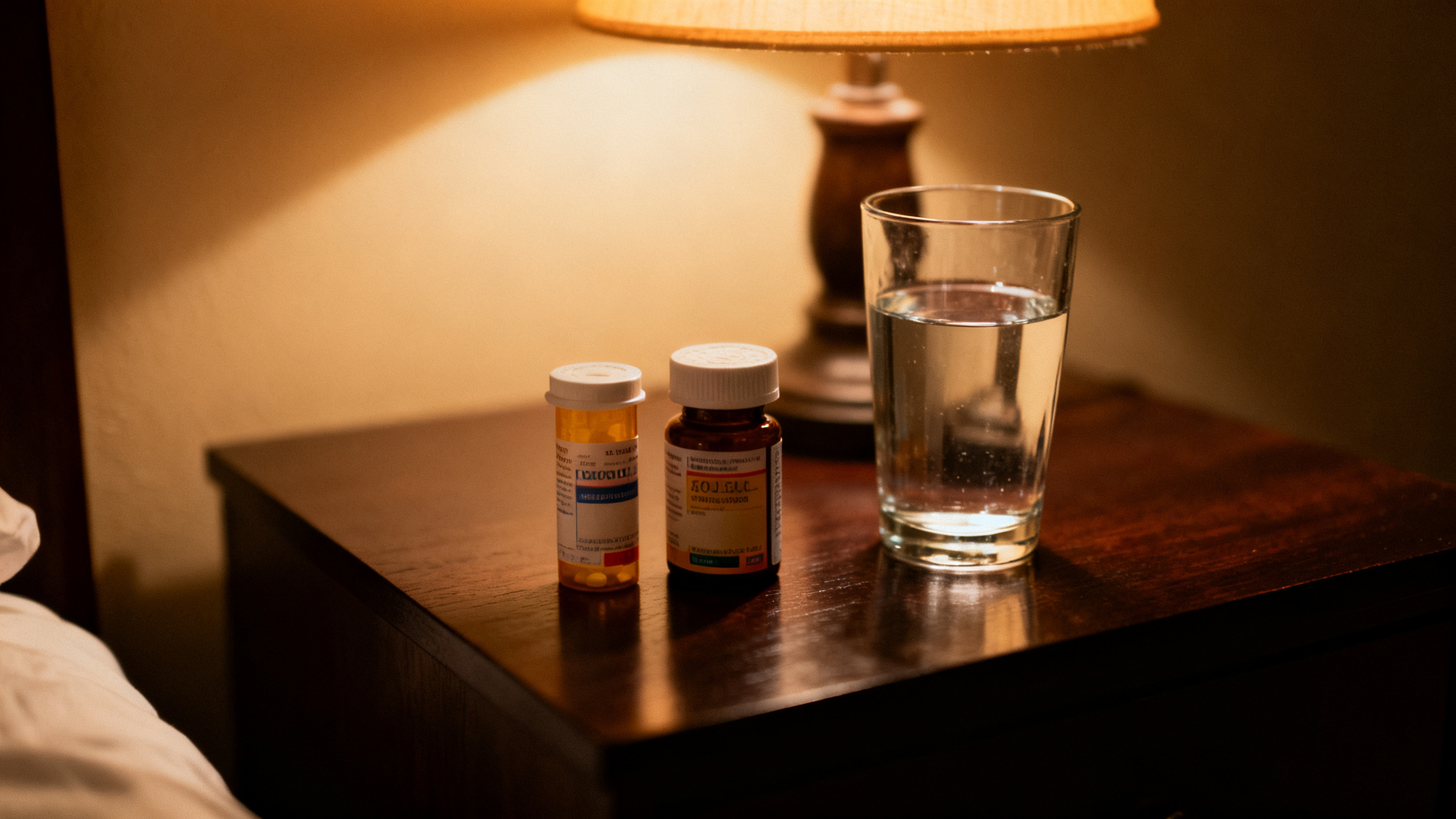
When the brain won’t stop running threat-detection in bed, hydroxyzine is often enough.
Mirtazapine (Remeron) at low dose, the depression-plus-insomnia combo
Mirtazapine is a tetracyclic antidepressant with a weirdly useful quirk, it’s most sedating at the lowest dose and less sedating as you go up, because at low doses the antihistamine effect dominates and at higher doses the noradrenergic effect kicks in and partially cancels it, so 7.5 to 15mg at bedtime is heavily sedating and 30 to 45mg is much less so, which is the opposite of how most medications work. Where it fits beautifully is the patient who has three problems in one chart, insomnia, low-grade depression, and either lost appetite or unintended weight loss, because mirtazapine at 7.5 or 15mg solves all three with one molecule, the patient sleeps, the depressive edge softens over the next month, and the appetite comes back. The weight gain is real and worth flagging up front (around five to ten pounds in the first three to six months, sometimes more), and for the patient who’d lost weight involuntarily that’s the point, while for the patient who didn’t want to gain weight, mirtazapine is the wrong lane.
Insomnia, low mood, and lost appetite, one low dose can handle all three at once.
Seroquel (quetiapine) at low dose for sleep, the pattern that creates new problems
Seroquel is a second-generation antipsychotic, approved for schizophrenia, bipolar disorder, and as an adjunct in major depression. At 25 to 100mg it’s heavily sedating because of the antihistamine effect, and a lot of primary care has reached for it as an off-label sleep medication on the (wrong) reasoning that it’s “not addictive” so it must be safe. That reasoning misses the part where Seroquel has a metabolic side effect profile most sleep medications don’t carry, weight gain often substantial in the twenty to thirty pound range over a year, lipid changes with triglycerides going up sometimes meaningfully, glucose dysregulation, and a real signal for new-onset type 2 diabetes in patients on long-term Seroquel even at the low doses used for sleep.
This is not a first-line sleep medication, it’s at best a third or fourth line option in a patient who has failed several cleaner classes, and it carries a metabolic bill the patient should be told about before the first dose. The pattern I see often is the guy put on 50mg of Seroquel for sleep by a prior prescriber, on it two or three years, thirty pounds heavier, A1c crept into the prediabetic range, and nobody connected the dots back to the medication, because the medication is for “sleep” and the weight is supposed to be a separate problem. It isn’t separate, the medication is doing the weight, the lipids, and the glucose, and the patient who has been on Seroquel for sleep for two years is paying a metabolic price that probably wasn’t worth it. The narrow defensible use is the patient with bipolar disorder where Seroquel is doing real psychiatric work and the sleep effect at low dose is a bonus, or the patient who has failed every cleaner option and decided the metabolic risk is worth the sleep. Otherwise the right answer is to taper off and reach for something cleaner.
The patient on Seroquel for sleep who gained thirty pounds in a year is paying a metabolic bill the original conversation never named.
Screen for sleep apnea before the pill conversation gets interesting
The pill conversation in a patient with untreated obstructive sleep apnea is a wasted conversation, and screening is cheap, so we do it first. STOP-Bang is the shortcut tool, eight yes/no questions covering snoring loud enough the partner hears it through walls, daytime tiredness despite adequate time in bed, observed apneas, elevated blood pressure, BMI over 35, age over 50, neck circumference over seventeen inches in men, plus male sex as a baseline risk multiplier, and three or more yeses warrants a sleep study. The guy who comes in for insomnia with snoring plus daytime fatigue plus a neck circumference over seventeen has untreated OSA until proven otherwise, and writing him a trazodone script makes the apnea worse because most sleep medications relax the upper airway and worsen the events. The before-and-after on CPAP in a patient who actually has moderate-to-severe OSA is dramatic, the daytime sleepiness lifts, the brain fog lifts, the testosterone often comes back online, the cardiovascular risk drops, and the chronic insomnia complaint sometimes resolves on its own. Don’t skip this screen.
Write a sleep script for a guy with untreated apnea and you’ve just made the apnea worse.
CBT-I, the answer the field underuses because it requires work
Cognitive behavioral therapy for insomnia (CBT-I) is the best long-term answer for chronic insomnia based on the data, and the field underprescribes it because it requires time, effort, and a referral to somebody who specifically does it. The trial data is consistent, CBT-I produces durable improvements in sleep that outlast medication, doesn’t carry side effects, and the effect size in moderate-to-severe chronic insomnia is bigger than most of the pill options on this list. The protocol is short (six to eight sessions usually) and works on sleep restriction (which sounds counterintuitive and is the part that does the heavy lifting), stimulus control (the bed is for sleep and sex, not for scrolling and lying awake), and cognitive restructuring (the catastrophic thoughts about not sleeping make the not sleeping worse). The honest framing is that CBT-I plus a short course of a sleep medication is usually the cleanest path, the medication carries the patient through the first few weeks while the behavioral piece sets up, and then the medication can come off because the behavioral piece is doing the actual long-term work. App-based programs (Somryst is FDA-cleared, others exist) are reasonable in markets without enough providers. If you’ve been chronically insomniac for years and you’ve never actually tried CBT-I, that’s the gap.
Patterns I see, illustratively, not biographically
The eight-years-on-Ambien pattern. A patient was put on Ambien during a stressful stretch years ago, the stretch passed, the prescription kept getting refilled, and now he’s scared to stop because the few times he’s tried, the rebound insomnia hit and he restarted within three nights. The taper plan is slow (dropping by a quarter every two to three weeks, sometimes bridging with trazodone or doxepin, sometimes pairing with a brief CBT-I course), it works most of the time, and the patient ends up sleeping as well or better off it than he did on it, with a clearer morning brain.
The depression-plus-insomnia-plus-weight-loss pattern. A patient walks in with three problems on the chart (lost weight he didn’t intend to lose, sleeping four hours a night, mood is a mess), and on 7.5mg of mirtazapine at bedtime within six weeks all three are noticeably better, with the sleep arriving first, the appetite a few weeks in, the mood last.
The anxious-can’t-shut-off-in-bed pattern. A patient lies down, the brain immediately starts running a threat-detection loop on tomorrow, can’t sleep until 1 or 2 AM, doesn’t feel rested in the morning, and hydroxyzine 25 to 50mg at bedtime (used as needed three or four nights a week) takes the volume down so sleep arrives more reasonably, and because hydroxyzine isn’t addictive the patient doesn’t end up owning a new problem. Sometimes the medication’s job ends after a few months because the patient also addressed the underlying anxiety with therapy or an SSRI and the bedtime loop went quiet on its own.

Where I land on the sleep medication question
The hierarchy I work from, roughly. Sleep hygiene and behavioral work first because they’re free and durable. CBT-I added when the insomnia is chronic. Trazodone as the medication first call for most patients because it works, it isn’t addictive, and the cost is low. Low-dose doxepin or Silenor where trazodone is too groggy or the maintenance piece is the bigger problem. Ramelteon for the patient who needs the cleanest profile and can accept a modest effect. The DORAs for the patient who needs better maintenance and has tried the cleaner options. Hydroxyzine for the anxious overlay. Mirtazapine for the depression-plus-insomnia-plus-appetite picture. Z-drugs for short courses with a clear endpoint, not as the standing answer. Seroquel reserved for the patient where the metabolic bill is worth it for specific reasons. Benzos for narrow acute contexts, not as the chronic prescription.
The framing patients need most is that the pill picks the chemistry and the work picks how durable the result is, the pill can buy you sleep tonight and the work decides whether the sleep is still here in two years without the pill in the system. Most prescribers end up writing the script and skipping the work conversation because the appointment is fifteen minutes and the work conversation is forty, and we all keep doing that, and the patient keeps coming back, and the prescriptions keep getting refilled. That’s the loop, and breaking it is part of why this piece exists at all. If you’re already on a sleep medication and it’s working and the trade-offs are acceptable, fine. If you’ve been on it for years and nobody has revisited it, that’s a conversation worth having. If you’re sleeping badly and haven’t started any of this yet, the order I’d reach for is the work first, the cleaner medications second, and the heavier classes last, and any prescriber who jumps to the heavy classes first is either rushed or wrong. Both choices are yours, and any prescriber telling you the pill is the work is selling you a story that won’t hold up over time. The work belongs to you, the leverage we pick together, and the sleep is supposed to come back not because the pill solved it but because the conditions for sleep were rebuilt while the pill bought time.
Sources
American Academy of Sleep Medicine Clinical Practice Guideline for the Pharmacologic Treatment of Chronic Insomnia in Adults (Sateia MJ et al, J Clin Sleep Med 2017). American College of Physicians Clinical Practice Guideline on the Management of Chronic Insomnia Disorder in Adults (Qaseem A et al, Ann Intern Med 2016). FDA prescribing information for zolpidem (Ambien), eszopiclone (Lunesta), zaleplon (Sonata), suvorexant (Belsomra), lemborexant (Dayvigo), daridorexant (Quviviq), ramelteon (Rozerem), doxepin (Silenor), trazodone, mirtazapine (Remeron), quetiapine (Seroquel), hydroxyzine, temazepam (Restoril), and clonazepam (Klonopin). Everitt H, Baldwin DS, Stuart B, et al, Antidepressants for insomnia in adults, Cochrane Database of Systematic Reviews 2018, CD010753 (the review that found only low-quality, short-term evidence behind the off-label antidepressant approach, including a small benefit for low-dose doxepin and trazodone). Montgomery P, Dennis J, Cognitive behavioural interventions for sleep problems in adults aged 60+, Cochrane Database of Systematic Reviews 2003, CD003161. Sleep journal and the Journal of Clinical Sleep Medicine for the maintenance and onset data across the orexin antagonist class. AASM and APA practice parameters on cognitive behavioral therapy for insomnia.