Trazodone is the most prescribed sleep medication in the United States that was never actually approved as a sleep medication. Built as an antidepressant in the 1960s, came to market in 1981, quietly got demoted to a sedative because at antidepressant doses it knocked everybody out before the mood lift kicked in. Somewhere in the late nineties, psychiatrists started writing it at 25 or 50mg at bedtime for insomnia and it took over the country… about a million prescriptions a month, and the vast majority of them off-label, for a use case that was never the original design. Which is honestly half of psychiatry, drugs that did the job they were assigned badly and ended up being beloved for the job they did by accident.
Trazodone is the most prescribed sleep medication in the United States that was never actually approved as a sleep medication.
It’s a SARI, a serotonin antagonist and reuptake inhibitor, which is a fancy way of saying it does two different things in the brain depending on the dose. At higher doses it acts like a weak SSRI (the serotonin antidepressant class). At lower doses the antihistamine and alpha-1 blockade dominate, which are the receptors that make you sleepy. That split personality is why 50mg and 300mg feel like fundamentally different drugs, and why most patients on trazodone have never taken anything close to a real antidepressant dose of it.
I write a lot of it. Most psychiatrists do. It’s not glamorous, it’s not new, it works.
The dose hierarchy nobody actually explains
Trazodone is one of those drugs where the dose changes what it is. Patients get confused by this because the bottle just says “trazodone 50mg” and doesn’t tell you that 50mg and 300mg are doing fundamentally different jobs upstairs.
At 25 to 50mg, you’re getting almost pure sedation through H1 histamine blockade (the same receptor old-school Benadryl works on) and alpha-1 adrenergic blockade. That’s the sleep dose. It puts you down, holds you down for six or seven hours, and doesn’t really touch mood. Most patients land somewhere in this range.
At 100 to 150mg you’re still using it for sleep but starting to nudge the serotonin system. Some patients get a mild anti-anxiety effect at this range, which is useful when sleep and anxiety are tangled. You also start seeing more morning grogginess.
At 200 to 400mg you’re using it as an actual antidepressant. Almost nobody tolerates these doses for long because the sedation is brutal. The studies that got it FDA-approved for depression were run at these doses, and it works there, we just have a hundred better-tolerated antidepressants now. The original use case basically evaporated and the off-label use case ate the whole market, which is what you get when the marketing budget for the new use is zero dollars and prescribers had to find each other by word of mouth.
The other thing nobody tells patients is that 50mg and 100mg aren’t twice the sedation. The dose-response curve flattens fast. Most people get 95 percent of the sleep benefit at 50mg and just add side effects past that.
How it became the go-to instead of Ambien
Twenty years ago, if you walked into a primary care office complaining about insomnia, you walked out with Ambien (zolpidem, the Z-drug class). That’s largely stopped. The FDA black-boxed the Z-drugs for sleepwalking and complex sleep behaviors in 2019, which most prescribers had been worried about for a decade. Guys were eating in their sleep, driving in their sleep, having sex they didn’t remember. The drug class works, the risk profile got harder to ignore.
Trazodone slid into that vacuum, and it has a few things going for it that the Z-drugs and benzos don’t. No physical dependence in any meaningful way… you can stop it. Some guys get a rebound insomnia for a couple of nights when they stop, which isn’t real withdrawal so much as the underlying sleep problem coming back, but there’s no shaking, no seizures, none of the benzo-taper nightmare.
No abuse potential, either. There’s no street value. Nobody is crushing trazodone to snort it. You can give it to somebody with a substance use history without losing sleep yourself, which is a real selling point in this population. And it plays well with antidepressants… half the insomnia patients walking in are already on an SSRI that’s making their sleep worse, and trazodone layers on top without serotonin syndrome being a real worry at sleep doses. That combination (an SSRI for the depression plus low-dose trazodone for the SSRI-induced insomnia) is probably the single most common combo in outpatient psychiatry.
What’s nice to hear about it
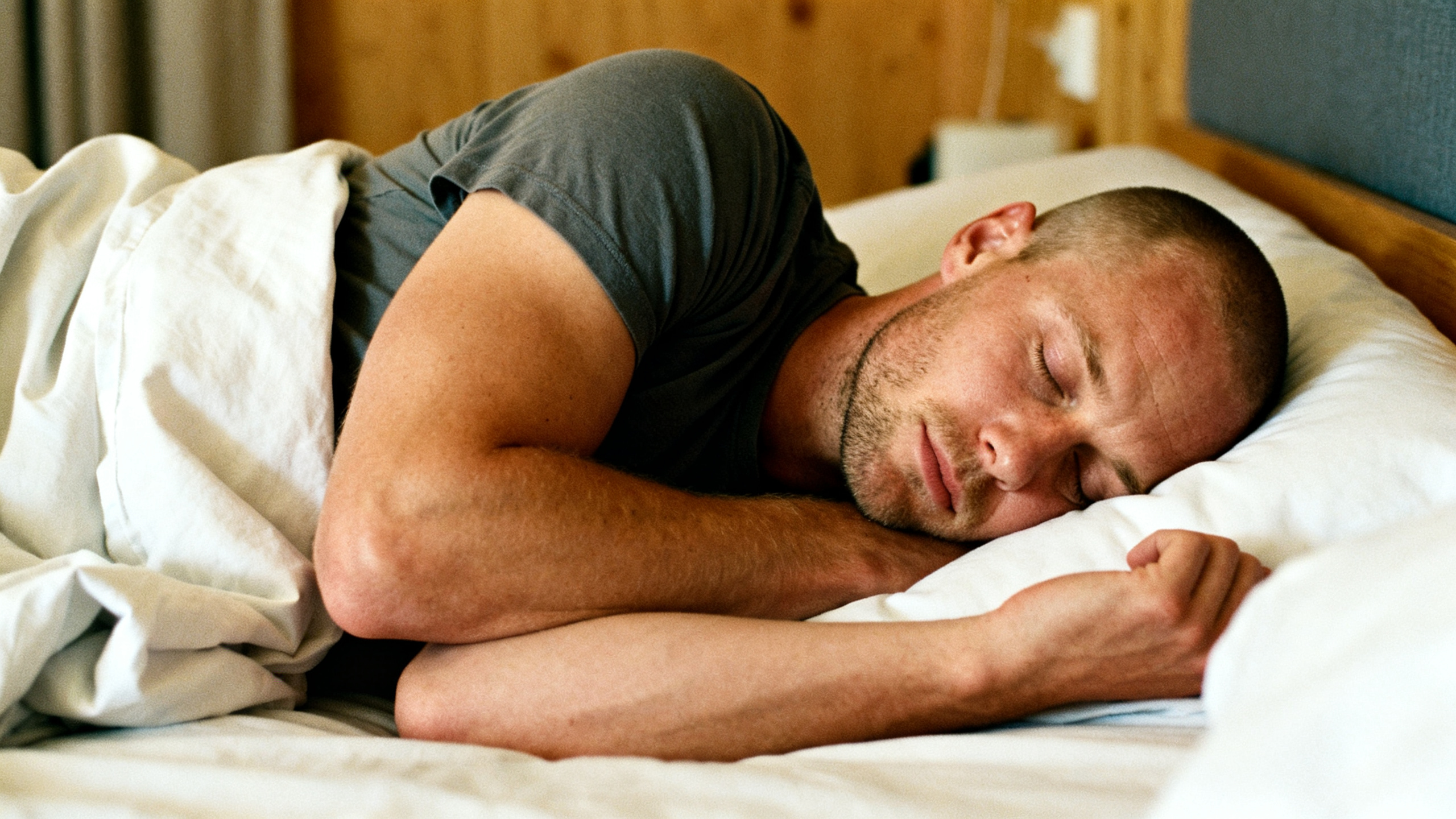
The reason this drug has stuck around as the default sleep med for psychiatrists isn’t just that it’s not Ambien. For the guy who’s been beating himself up over not sleeping for months, who’s tried melatonin and Benadryl and his uncle who knows a guy who swears by ZzzQuil, the move to 50mg of trazodone at bedtime is sometimes a small revelation. You get tired, you go to bed at a normal hour, you stay asleep through the night, you wake up at 6 AM instead of 3 AM… and you keep getting that benefit night after night without the dose creeping up, without the morning hangover of a Z-drug, without the slow physical dependence of a benzo. Sleep architecture stays closer to normal, the deep sleep that actually rebuilds you is preserved, and the partner who’s been complaining about your snoring-and-tossing routine starts sleeping again too. That’s the version the drug delivers when it works, and it works for a lot of people. Worth saying out loud before all the warnings.
Every man on trazodone needs to be told about priapism. Small risk, real risk, and the guys who weren’t warned were the angriest patients I’ve ever had.
Where it loses, and the warning that needs saying
Morning grogginess is the main complaint. Trazodone has a half-life of about seven hours, which sounds fine until you realize somebody who takes it at 11 PM still has half of it on board at 6 AM. A solid third of patients describe the first hour of the morning as wading through mud, which improves over the first couple of weeks but doesn’t always go away entirely.
Compared to Ambien, you don’t get that fast knockout feeling. Trazodone takes 30 to 60 minutes to work and the sedation rolls in slowly rather than hitting you over the head. Most people switching from a Z-drug complain about this for a few weeks before they adjust. The flip side is that the sleep you get on trazodone is closer to normal sleep, where the Z-drugs give you a kind of pharmacologically-shaped sleep that doesn’t refresh you the same way.
Then there’s priapism. This is the thing every guy on trazodone needs to actually be told about, and a lot of prescribers gloss over it because the rate is low, somewhere between 1 in 1,000 and 1 in 10,000 men. The alpha-1 blockade that helps you sleep can, rarely, cause a sustained painful erection that doesn’t go away. If it lasts more than four hours, that’s a urology emergency. You go to the ER. If it goes long enough untreated, the tissue damage in the groin is permanent, and you may not get a functioning erection back. Small risk, real risk, needs to be named when the prescription is written. The patients who weren’t warned were the angriest ones I’ve ever had… and reasonably so, because nobody handed them a bottle saying “by the way, this drug for sleep can wreck your sex life if that rare event hits you and you don’t know what to do about it.” Wait, can prescribers actually leave that out? They can, and they often do, which is a problem.
25 to 150mg for sleep
Most patients land at 50 or 100mg at bedtime. Going higher mostly adds grogginess. Antidepressant dosing starts around 200mg and almost nobody tolerates it long-term.
30 to 60 minutes
Slower than Ambien, rolls in rather than crashes. Sleep architecture stays close to normal, so morning function tends to be better at the same sedation depth.
Priapism in men
Low, somewhere between 1 in 1,000 and 1 in 10,000. An erection lasting over four hours is an ER trip. Untreated damage can be permanent. Every male patient deserves to hear this before the first pill.

Trazodone versus mirtazapine, the actual decision
If trazodone is the most-prescribed off-label sleep drug, mirtazapine (Remeron, an older sedating antidepressant that hits histamine receptors hard) is the runner-up, and the choice between them is one of the more common micro-decisions in outpatient psychiatry. Both are sedating antidepressants used at low doses for sleep. They do different things underneath.
Mirtazapine is heavier. The 7.5 and 15mg doses hit harder than trazodone 50mg, and it reliably stimulates appetite, which is great for the underweight depressed patient who hasn’t eaten in three weeks and a problem for everyone else. Patients gain weight on mirtazapine. Not always, often enough that I bring it up before writing the prescription.
Trazodone is lighter, weight-neutral, easier to titrate. The downside is the priapism risk in men and the morning grogginess.
The practical sort: if the patient is underweight, has poor appetite, or has severe anxiety stacked on top of insomnia, mirtazapine usually wins. If the patient is already at a healthy weight and just needs sleep, trazodone wins. For a guy where the priapism conversation is a dealbreaker, mirtazapine. For some patients on a quiet stretch already, more often trazodone.

The patient who’s been on it for a decade
The pattern, details filed off: somebody started trazodone 100mg years ago after a rough stretch, tried Ambien briefly, didn’t like the way it felt, switched to trazodone, never came off. Annual visits go the same way… do you still need this, have you tried a few nights without it, what happens when you skip. The answer is always the same. Sleeps fine on it, badly off it, has tried tapering twice and bounced both times. No tolerance escalation. Same dose for a long stretch. Liver and kidneys check out. No falls.
At some point the question stops being “should this person be on this forever” and becomes “what’s the cost of taking somebody off something that’s working.” There isn’t really one. Trazodone at low dose has one of the cleanest long-term safety profiles of any psychiatric drug. The version of that patient without it has worse sleep, worse mood, worse functioning. So they stay on it and we check in once a year. That’s how most long-term trazodone patients look… somebody who sleeps better with a small pill at bedtime and worse without one. There are worse drugs to be on for a decade.
One more thing on the autonomy piece. If you want it, you get it. I’m a provider, not a parent. My job is the honest take, your job is the choice. With trazodone the honest take is mostly cheerful. The priapism conversation is real and has to happen, the morning grogginess is real and you’ll know in two weeks whether it’s going to fade or not, and after those two things are dealt with the drug mostly just does its job quietly. Which is a higher bar than a lot of the louder drugs in this field can clear.
Sources
- Mendelson WB. A review of the evidence for the efficacy and safety of trazodone in insomnia. J Clin Psychiatry. 2005;66(4):469-476. PMID 15816789.
- Yi XY, Ni SF, Ghadami MR, et al. Trazodone for the treatment of insomnia: a meta-analysis of randomized placebo-controlled trials. Sleep Med. 2018;45:25-32. PMID 29680424.
- Cuomo A, Ballerini A, Bruni AC, et al. Clinical guidance for the use of trazodone in major depressive disorder and concomitant conditions: pharmacology and clinical practice. Riv Psichiatr. 2019;54(4):137-149. PMID 31379379.
- Everitt H, Baldwin DS, Stuart B, et al. Antidepressants for insomnia in adults. Cochrane Database Syst Rev. 2018;5(5):CD010753. PMID 29761479.
- Kadiyala S, Chenoweth M, Watanabe JH. Off-label policy through the lens of trazodone usage and spending in the United States. Health Aff Sch. 2025;3(7):qxaf114. PMID 40692815.