Sections
The weight management conversation got rewritten in the last three years and most people still haven’t caught up. The drugs that did the rewriting are GLP-1 agonists. Semaglutide, sold as Ozempic for diabetes and Wegovy for weight loss. Tirzepatide, sold as Mounjaro and Zepbound. They’re the biggest shift in obesity medicine since bariatric surgery, and unlike most things that show up with that kind of hype, they actually work, which is rare enough in this corner of medicine that I’m going to lead with it instead of burying it.
The asterisks are real though. A guy who’s been carrying 60 extra pounds for a decade can lose 35 of them on a once weekly shot without spending his life hungry, which is a thing the field genuinely hasn’t been able to offer before in any non-surgical form. The drug isn’t fixing the underlying setup, and the compounded “semaglutide” that some telehealth clinic is shipping from a strip mall pharmacy in Florida isn’t the molecule that was studied in the STEP trials, it’s something adjacent.
The two issues nobody likes talking about are muscle loss and the rebound when you stop. The rebound is the big one. If you don’t have a plan for what happens when you stop, you’re not really planning your weight loss, you’re renting it.
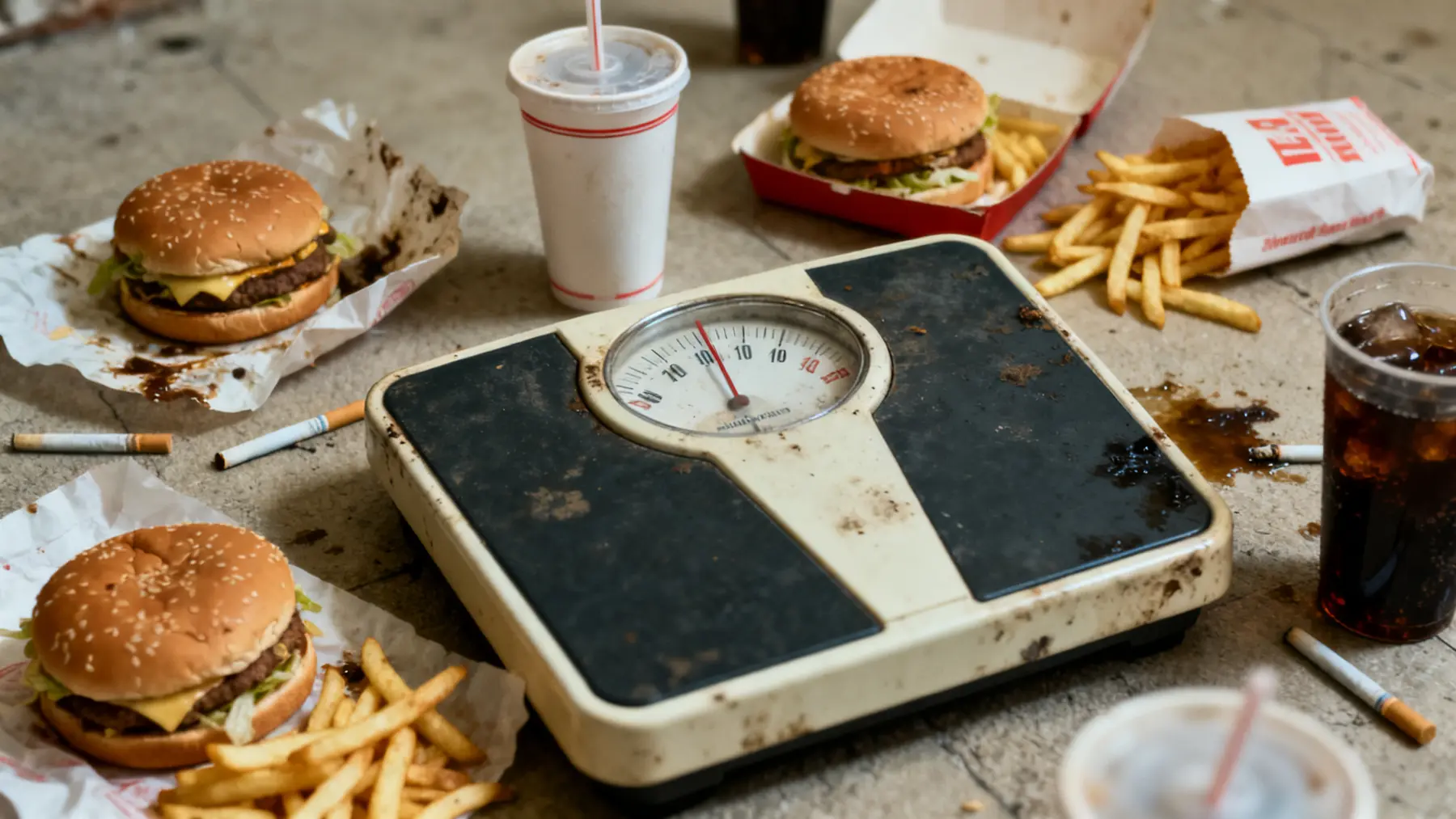
The shot quiets the food noise for a while, but it won't build the habits that keep weight off once the effect fades.
How the molecule actually does what it does
GLP-1 stands for glucagon-like peptide-1, and your gut already makes it, in small amounts, as part of the signaling system that tells your brain you’ve eaten enough and tells your pancreas to release insulin when glucose shows up after a meal. The drugs are synthetic versions of that hormone, tweaked so they last a week in your bloodstream instead of the few minutes natural GLP-1 lasts.
Three things happen when you inject one, which I’ll string together rather than list as bullets because that’s actually how they connect. Your stomach empties slower, so food sits there longer and you feel full on smaller portions… your appetite signaling in the hypothalamus (the part of the brain that runs hunger and fullness) gets dampened, so the constant background hum of “I could eat” gets quieter… and your glucose handling improves, which is why these drugs were diabetes meds first and obesity meds second. The hunger reduction is the part patients describe the loudest. People tell me food just stopped being interesting in the way it always had been, the mental real estate that used to be occupied by thinking about what’s for lunch just goes quiet, which for somebody who’s spent thirty years thinking about food more than he wanted to is the whole point.
Tirzepatide adds a second receptor in the same family (GIP) and tends to beat semaglutide in the head to head data. Roughly 15 to 20 percent body weight loss on tirzepatide versus 12 to 15 percent on semaglutide in the trials, though individual results swing around a lot.
Who’s actually a candidate
FDA labeling is BMI 30 or higher, or BMI 27 or higher with a weight-related comorbidity like high blood pressure, sleep apnea, or type 2 diabetes. Insurance draws tighter lines than that. The practical question I ask is whether the guy has tried to lose weight on behavior alone, what got in the way, and whether his metabolic picture justifies a medication he’s going to be on long-term.
The most common version of this story is a guy who’s been on three different weight loss programs in the last six years, hits the same loop every time. Mid-30s to mid-40s, BMI somewhere between 32 and 36, prediabetic on the labs, has a CPAP machine collecting dust under the bed because he hated wearing it. He’d lose twenty pounds, hit a stretch where work got hard or somebody he loved got sick, and the weight would come back over the next year and then some. He’s done that loop three times. He comes in tired of doing it. We start semaglutide or tirzepatide, get him lifting twice a week with a trainer because he won’t do it on his own, and at the year-plus mark he’s lost forty pounds and his CPAP is genuinely not needed for the apnea anymore, which becomes its own conversation about staying off it or not. That’s the success case and it’s not rare, it’s actually pretty common when the patient is in the right place to use the medication well.
The patients I’m more cautious about are the ones at BMI 28 with no metabolic flags who want to drop fifteen pounds for aesthetic reasons. The drug will probably work for them, the question is whether they’re signing up for a medication they’ll be on indefinitely to maintain a result behavior could plausibly handle. Most haven’t thought through that part yet. I’ll still write the script if that’s what they want after we’ve actually had the conversation. I’m a provider, not a parent, and the appointment isn’t mine, but I’m going to make it a disapproving yes where they walk out knowing what they’re signing up for.

The compounded gray-pharmacy mess
This part got complicated in 2024 and 2025. When demand for Ozempic and Wegovy blew past supply in 2022 and 2023, the FDA’s drug shortage list let compounding pharmacies legally produce semaglutide as an alternative. Telehealth clinics flooded the space. Compounded semaglutide started shipping to people’s doors for a fraction of branded pricing, on the strength of a 90-second video intake from somebody who’d never met them.
Then the shortage ended. FDA declared the tirzepatide shortage resolved in October 2024 and the semaglutide shortage resolved in February 2025. Compounding pharmacies got grace periods to wind down: 503A state-licensed pharmacies through April 2025 for semaglutide, 503B outsourcing facilities through May 2025. Those deadlines have all passed. The mass-market compounded telehealth pipeline is supposed to be off now, though some 503A pharmacies continue to compound for individual patients when there’s a documented clinical reason the FDA approved product doesn’t fit.
The active ingredient in a lot of the older compounded product was a salt form (semaglutide sodium, semaglutide acetate) that was never studied for safety or effectiveness in humans. Sterility varied pharmacy to pharmacy. Some patients were underdosed. Some were overdosed and ended up in the ER unable to stop vomiting. None of that gets better after the shortage ends, the older product is still circulating and the operators who weren’t careful in 2023 aren’t suddenly careful now.
If your “semaglutide” costs $200 a month and arrives in an unlabeled vial in a baggie from a pharmacy you’ve never heard of, you’re not on the drug from the trials, you’re on something adjacent to it. Just get the prescription.
This isn’t a blanket no on compounding. The 503A patient-specific compound space exists for real reasons, and a clinician you trust recommending one for a documented reason is a different situation than a vial showing up from a telehealth setup that asked you four questions before charging your card. If you’re going to do compounded, verify the pharmacy is properly licensed, ask what form of the active ingredient they’re using, and have somebody clinical actually following you, not a 90-second video intake from a kid in a polo shirt who works out of a co-working space.
Side effects, muscle loss, and the part nobody warns you about
The GI side effects get all the attention. Nausea is the headliner, especially in the first few weeks and after every dose bump. Vomiting in a smaller percentage. Constipation is constant for some patients. Most of it fades. A subset of guys can’t tolerate the drug at any dose. The titration schedule exists for a reason and rushing it’s how people end up miserable enough to quit.
Less common but real: gallstones (rapid weight loss does this regardless of mechanism, and GLP-1s seem to nudge gallstone formation specifically), pancreatitis (rare but the signal is real, particularly if you’ve had it before), and a theoretical thyroid C-cell tumor risk that came from rat studies and hasn’t shown up in human data but still lives on the FDA label.
A real chunk of the loss is muscle
Without lifting, a big chunk of GLP-1 weight loss is lean mass. That’s worse metabolic outcome, worse function, worse aging. Lifting twice a week changes the ratio dramatically.
Two thirds comes back
STEP-1 extension data. Patients who stopped semaglutide regained about two thirds of their lost weight within a year. Appetite signaling returns to baseline. This is a chronic medication, not a course of antibiotics.
$900-1300/month list
Insurance is wildly inconsistent. Some plans cover it only for diabetes. Some require step therapy. Some flat-out exclude weight loss meds. Verify before you start. Stopping abruptly because of cost is the worst case scenario.
The muscle-loss issue is the one most patients don’t hear about until they’ve already lost the muscle, by which point it’s an annoying climb to get it back. Any real weight loss, GLP-1 or otherwise, takes lean mass along with fat. Without resistance training and enough protein (call it 1.2 to 1.6 grams per kilogram of body weight per day (Arslan 2026)), you end up smaller but metabolically worse off. Slower resting metabolism, weaker grip, harder to keep the loss going. Every patient I start on one of these is signing up for a strength program too. Two sessions a week, compound movements (the squat-deadlift-bench-press family, not curls), progressive overload. Non-negotiable if I’m prescribing.
The rebound piece is the part the marketing won’t mention. When you stop semaglutide, gastric emptying speeds back up, appetite signaling comes back, hunger comes back with interest. The STEP-1 trial extension followed people for a year after they came off semaglutide and found they regained about two thirds of the weight they’d lost. Before you start, you need to be honest with yourself about whether you’re prepared to take this medication for years, possibly indefinitely, and what your off-ramp looks like if cost or insurance changes.

What’s nice to hear about all this
The relief side that doesn’t get said often enough. People on these drugs talk about the food noise going away in a way that’s actually startling to them. Thirty years of always thinking about the next snack, the calculations about whether to eat, the negotiations with themselves about leftovers, the willpower budget that ran out at 4pm every day, all of it just stops. They describe it as not having to be that version of themselves anymore. That’s not nothing. That’s the part that makes patients tearful talking about it six months in, and it’s the part the field tends to lead with the warnings on instead. The drug is genuinely impressive, the data is solid, and for the right patient it changes a thing that hadn’t ever changed for them despite years of trying. That deserves to get said before the rest of the disclaimers.
Where I land, and where you land is yours
Patient autonomy applies. If you want the GLP-1, you get it, my job is the honest take on what you’re signing up for, your job is what you do with that. I’m a provider, not a parent, and I hardly ever say no. If your metabolic numbers say you’re a textbook candidate and you want to try the boring stuff first (food noise won’t quiet down on its own, but a few months of real lifting plus protein-forward eating plus sleep can move metabolic numbers a surprising amount), I’m fine with that too, we recheck at six months.
The patients who do best are the ones who use the appetite-quieting as breathing room to build the habits they couldn’t build before. Lifting twice a week, protein at every meal, sleep that isn’t garbage, walking most days. The boring stuff nobody can sell you. The drug buys you a runway, and what you do with the year of food noise being quiet is the part that decides whether you have a body you can live in three years from now or whether the weight comes back with interest the minute you fall off the drug. Same molecule, different outcome, depending on what the patient does with the quiet year the drug bought them.