Disulfiram (Antabuse) doesn't kill cravings, it makes drinking miserable on purpose. Who the alcohol deterrent actually fits, and who should skip it.
Disulfiram is the old one. It came out of a rubber factory in the 1940s, got an FDA nod for alcohol use disorder in 1951, and it’s been sitting in the back of the pharmacy ever since while newer, gentler stuff got the attention.[1] It doesn’t touch cravings, it doesn’t calm your nervous system down or make you want a drink less, and what it does is way blunter than all that. It makes drinking on it physically miserable, on purpose, so the next time you reach for a beer your body files a complaint before your willpower even gets a vote.
So right up front, this is a niche drug. It’s not where most people start, and honestly it’s not where most people end up either. But for a specific kind of guy in a specific situation, it’s one of the few tools that does exactly what it says on the tin. Let’s walk through what it actually is, who it’s for, and who should leave it on the shelf.
What it actually is
Disulfiram is an alcohol deterrent. The brand name most people know is Antabuse, though the brand stopped being made in the US a while back and what you’ll get is the generic. It’s a plain prescription pill, not a controlled substance, nothing the DEA cares about. You take it once a day and it just sits in your system doing nothing at all… until you drink. That’s the whole catch. On its own it’s inert. The drinking is what turns it into a problem.
That makes it a strange animal compared to the other two FDA-approved alcohol meds, naltrexone and acamprosate. Those work on your brain to dial down the pull of alcohol. Disulfiram works on your liver and your gut, and it works on your fear. It’s less “I don’t want a drink” and more “I really don’t want what happens if I drink one.”
How it works (and it’s no mystery here)
This is one of the rare psych-adjacent drugs where the mechanism isn’t hand-wavy. We actually know exactly what it does. When you drink, your body breaks alcohol down in two steps. First it turns ethanol into acetaldehyde, which is genuinely toxic and is a big part of why hangovers feel like death. Then a second enzyme, aldehyde dehydrogenase, mops up that acetaldehyde fast and turns it into harmless acetate. Normally that second step happens so quick you never notice the acetaldehyde at all.[2]
Disulfiram jams that second enzyme. It blocks aldehyde dehydrogenase, so when you drink, the acetaldehyde piles up with nowhere to go. It can climb to five or ten times what it’d normally be.[2] And acetaldehyde at those levels makes you feel awful in a hurry.
The result is what’s politely called the disulfiram-ethanol reaction. Within ten or fifteen minutes of a single drink you get flushing across the face and chest, a pounding heart, throbbing headache, nausea and often real vomiting, sweating, and the kind of lightheaded “something is very wrong” feeling that makes you swear off the stuff. It can hit hard enough to drop your blood pressure. For most people it’s just brutally unpleasant. In rare cases, with enough alcohol, it can be dangerous, which is the part nobody should wave away.[3]
It doesn’t make you stop wanting a drink. It makes the drink hand you a bill you really don’t want to pay, and it makes you think about that bill before you pour.
So the drug isn’t really doing the work. You’re doing it. It just changes the math. Every day you take it, having a drink stops being a quiet little decision you can make on autopilot at 6pm and becomes a deliberate “am I willing to feel like garbage for the next few hours” choice. That pause, that extra step, is the entire point of the medication.
Who it’s actually for
Here’s where I’ll get honest, because the data is pretty clear and it cuts both ways. Disulfiram only works if you take it. That sounds obvious, but it’s the whole story. A 2014 meta-analysis of disulfiram for alcohol problems found that in open-label trials, where people knew they were on it, it helped. In blinded trials, where they didn’t know, the benefit basically vanished.[4] That tells you the magic isn’t in the chemistry, it’s in the knowing. The drug works because you know it’s in you and you don’t want the reaction.
Which means the guy this fits is a specific guy. He actually wants to quit, or at least take a hard break, and he’s got some structure around him. The best outcomes by a mile come from supervised dosing, where someone watches you take the pill every day. A wife, a brother, a sober-living house, a clinic counter.[5] Take that supervision away and most people just quietly stop taking it on the day they decide they want to drink, and then the drug does nothing.
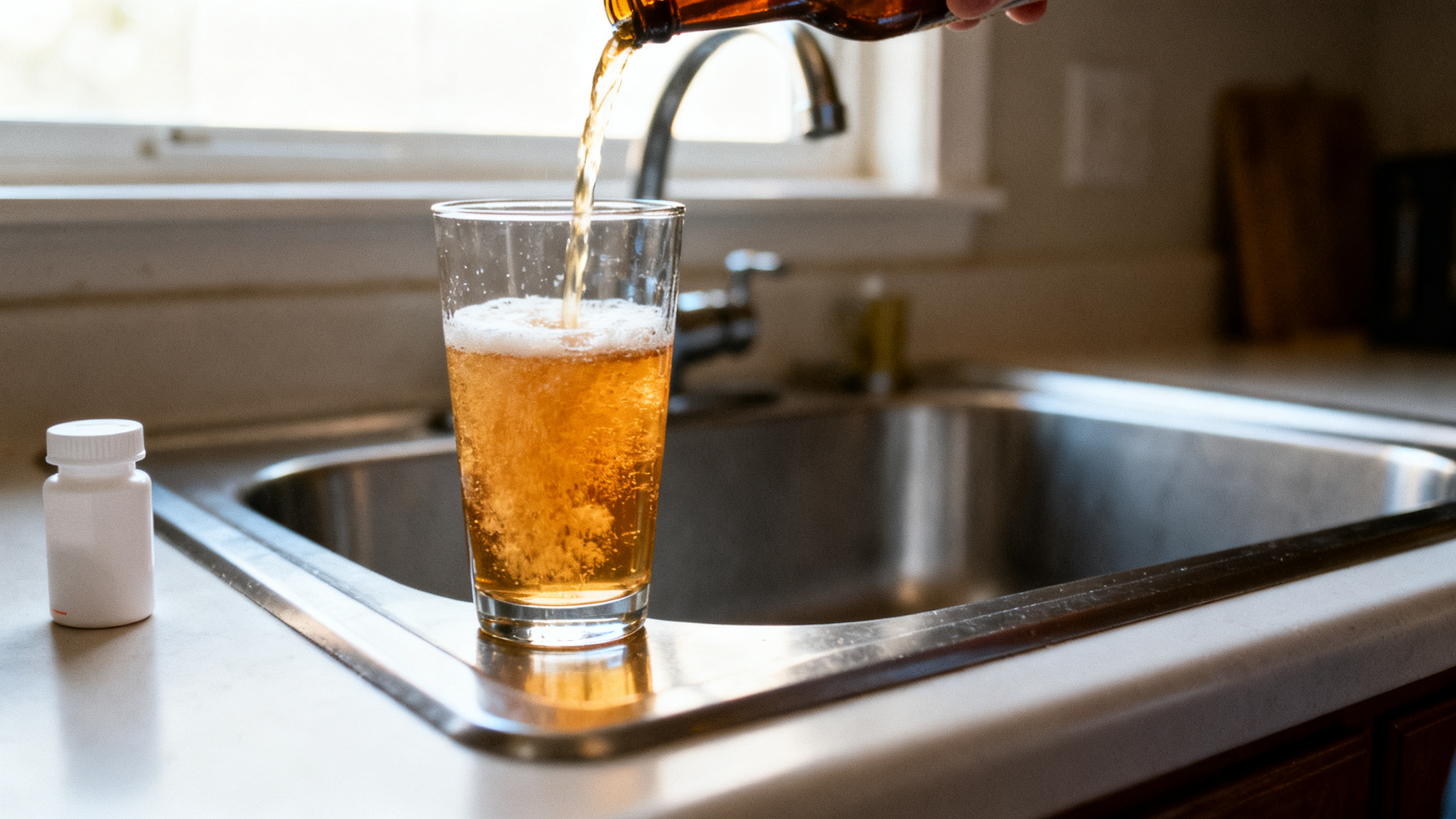
So who’s it not for. The ambivalent guy who’s “maybe gonna cut back” is a bad fit, because the second he’s on the fence he’ll skip the dose. Someone with serious heart disease, a history of stroke, or significant liver disease is usually a no, because the reaction itself can be risky for them. People with certain psychiatric conditions where it can make things worse, and obviously anyone who can’t reliably stay away from all the hidden alcohol sources we’ll get to in a minute. This is a motivated-patient-with-support drug, full stop. Used that way it can genuinely help. Used as a hopeful prescription handed to someone who isn’t ready, it’s just a pill that doesn’t get taken.
Starting it and the first couple weeks
First rule, and it’s non-negotiable, you’ve got to be dry before you start. You don’t take your first dose until you’ve had no alcohol for at least 12 hours, and most people wait a full day or two to be safe.[6] Starting it with booze still in your system is how you trigger the reaction you’re trying to avoid having by accident.
The typical maintenance dose lands around 250mg a day, sometimes up to 500mg, taken once daily.[6] If it makes you drowsy, plenty of guys take it at night instead of the morning. The drug itself, in the absence of any alcohol, is usually pretty quiet. Some people notice a metallic or garlicky taste in their mouth, mild tiredness, or a bit of a headache in the first week or two, and that tends to settle.
The thing to wrap your head around early is the long tail. Disulfiram doesn’t clear fast. After you take your last pill, the enzyme stays blocked for a while as your body slowly makes new enzyme, so you can still get a reaction if you drink for up to about two weeks after stopping.[6] That’s not a bug, but it does mean you can’t treat it like a daily on-off switch. If you’re on it, you’re committed to the no-alcohol rule for the whole stretch plus the tail.
The hidden alcohol problem nobody warns you enough about
This is the part that trips people up, and it’s worth slowing down on. When you’re on disulfiram, “no alcohol” means all alcohol, including the stuff you’d never think of as a drink. The reaction doesn’t care about your intentions, it just reacts to ethanol.
So we’re talking about mouthwash, which is often loaded with alcohol, swap to an alcohol-free one. Hand sanitizer in large or repeated amounts. Aftershave and colognes splashed on heavily. Cough syrups and cold meds, a lot of which are alcohol-based, read the label. Some vinegars, certain sauces, anything cooked with wine where the alcohol didn’t fully cook off, and even kombucha. None of these is going to feel like cheating, which is exactly why they catch people. You take a swig of mouthwash on autopilot and twenty minutes later you’re flushed and queasy wondering what happened.[3]
It’s not as scary as it sounds once you’ve done a sweep of your bathroom and kitchen and swapped the obvious offenders. But it does ask for a level of attention that, again, only a motivated person is going to keep up. If reading every label for two weeks sounds exhausting and pointless to you, that’s useful information about whether this drug fits where your head is at right now.
The serious-but-rare stuff, in proportion
Two things to take seriously and keep in perspective. The first is the liver. Disulfiram can, rarely, cause hepatotoxicity, real liver injury, and in very rare cases it’s been severe.[3] Because of that, the standard practice is to check your liver enzymes before you start and then periodically while you’re on it, and to flag anything weird right away, dark urine, yellowing eyes, pain under the right ribs, deep fatigue. Rare doesn’t mean zero, so the monitoring isn’t optional.
The second is the reaction itself getting out of hand. In most people a slip-up means a few hours of feeling wretched. But a big drink on a full dose, especially in someone with heart trouble, can occasionally cause something serious, a sharp blood pressure drop, irregular heartbeat, in extremely rare reported cases worse.[3] That’s the real argument for screening out people with cardiac disease and for being straight with patients that this isn’t a drug to play chicken with.
There are a couple of rarer ones worth a mention so I’m not soft-pedaling. Disulfiram can occasionally cause nerve problems (peripheral neuropathy, or rarely optic neuritis affecting vision) and in rare cases a kind of confusion or psychosis at higher doses.[3] These are uncommon, but they’re why this is a doctor-monitored drug and not a set-it-and-forget-it one.
Interactions and a few caveats
Beyond alcohol, disulfiram messes with a few other things. It can raise levels of some drugs your liver processes, the blood thinner warfarin and the seizure med phenytoin are the classic ones, so doses sometimes need adjusting.[6] Mixing it with metronidazole (Flagyl, a common antibiotic) is a known bad combo. And it can interact with isoniazid. None of this is a reason to panic, it’s a reason to make sure whoever prescribes it has your full med list, including the supplements you didn’t think counted.
One more honest caveat about the evidence. For all that disulfiram has been around since before color TV, the trial evidence isn’t as strong as you’d hope, mostly because you can’t really blind a drug whose whole effect depends on you knowing you’re on it.[4] So the research is genuinely messy, and anyone telling you it’s a slam-dunk cure is overselling. What we can say is that for supervised, motivated patients, the open-label and real-world data are decent.[5] That’s a narrower claim, and it’s the true one.
The honest bottom line
Most people who want to drink less don’t need disulfiram, and most of them shouldn’t start here. The work of quitting is the work, the support, the structure, the reasons you wrote down, the people in your corner, and no pill does that part for you. If you’ve read why sobriety isn’t the hard part, you already know the pill is the easy bit. For a lot of guys, naltrexone or just an honest plan with real accountability and treatment is a better, lower-drama first move.
But disulfiram isn’t useless and it isn’t a relic to laugh at. For the right guy, the one who genuinely wants out, who’s got someone to watch him take the pill, and who’s willing to read his mouthwash label for a couple weeks, it can be the thing that keeps a hard month from turning into a relapse. It buys you a daily pause when you most need one. That’s a small, specific job, and when it’s the right job, it does it well. Like a lot of meds, it’s a good tool used carefully and a bad idea used hopefully, and knowing which one you’re doing is most of the battle.
Sources
FDA prescribing information for disulfiram via DailyMed, the source for the dosing, pharmacology, half-life, interaction, and side-effect details in this piece.
Inhibits aldehyde dehydrogenase, so acetaldehyde piles up if you drink, causing the flushing-nausea-pounding-heart reaction. No effect on cravings.
Works best for someone who genuinely wants out and has observed dosing (a partner or clinic). Poor fit for the ambivalent, since it does nothing if skipped.
Rare hepatotoxicity means baseline and periodic liver enzyme checks. Avoid in significant heart or liver disease; screen for hidden alcohol sources.